Sheet-pan liner comparison
Silicone Baking Mat vs Parchment Paper for Batch Cooking
A silicone baking mat is a washable liner sized for repeated use. Parchment paper is a disposable liner that can be cut or bought to fit. Neither is automatically better: the useful choice depends on the pan, the recipe and appliance directions, the maker's temperature limit, cleanup, storage, and how often you will actually use it.
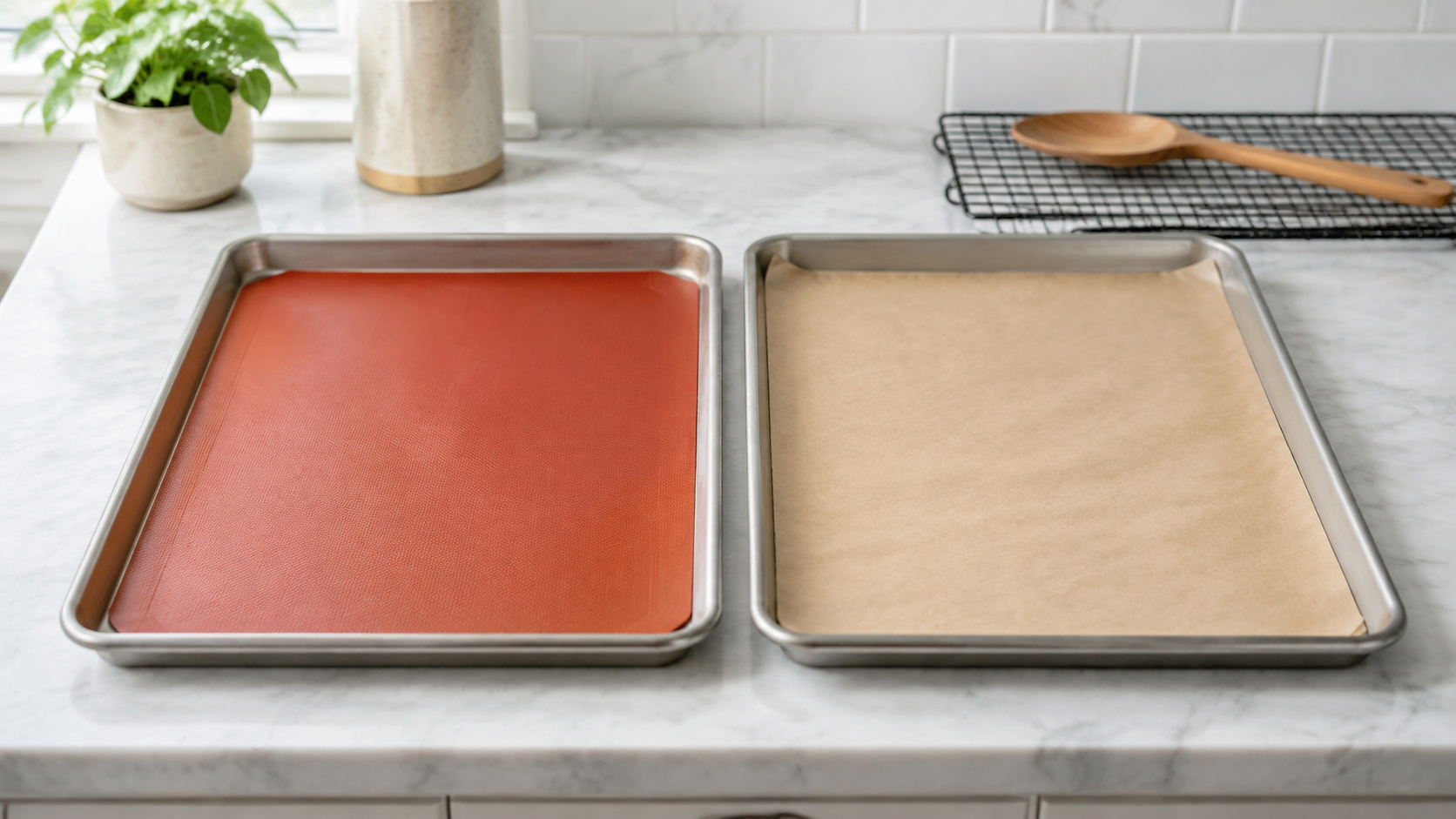
As an Amazon Associate, GoodWeighFinds earns from qualifying purchases.
Quick answer
Choose a silicone mat when its measured dimensions match a frequently used pan, the stated use limits fit your recipes, and you have an easy wash-and-store routine. Choose parchment when you use several pan sizes, line pans only occasionally, value quick disposal, or need a format the recipe specifically calls for. Use neither when the cookware, appliance, or recipe directions say to use an unlined or differently prepared surface.
How the formats differ
| Decision point | Silicone baking mat | Parchment paper |
|---|---|---|
| Fit | Fixed dimensions must sit flat inside the usable pan area without covering edges or vents. | Sheets or rolls can suit more pan shapes, but still need to be cut and placed as directed. |
| Use pattern | Designed for repeat use within the maker's stated limits. | Usually intended for a limited use stated on the package; do not assume reuse. |
| Cleanup | Adds a washable item and needs complete drying before storage. | Reduces liner washing but creates used paper to handle after cooking. |
| Storage | Needs protected flat or maker-approved rolled storage. | A roll needs cutting space; flat sheets need a clean, dry drawer or box. |
| Cost pattern | Higher initial purchase with value depending on actual repeat use and replacement. | Lower commitment per package with an ongoing replacement cost. |
| Claims to verify | Dimensions, temperature limit, appliance compatibility, care, and expected replacement signs. | Dimensions, temperature limit, coating or material description, intended uses, and disposal directions. |
Measure the pan before choosing
Measure the flat interior cooking surface, not only the pan's outside dimensions. A mat that rides up a rim, overlaps an edge, blocks an appliance vent, or needs to be cut when its maker prohibits cutting is the wrong fit. For parchment, check whether a precut sheet sits inside the pan or whether a roll can be trimmed without leaving loose overhang near heat.
Pan names such as half-sheet or quarter-sheet are useful starting points, but actual dimensions and usable interior space can vary. Verify the liner and pan measurements directly. Follow the oven, air-fryer, toaster-oven, cookware, liner, and recipe instructions; this comparison does not establish compatibility across appliances.
Temperature and use labels come first
Do not treat “oven safe,” “heat resistant,” or “nonstick” as complete instructions. Check the exact stated maximum temperature, permitted appliance types, placement restrictions, preheating guidance, distance from heating elements, broiler restrictions, and whether direct flame or stovetop use is prohibited.
The lowest applicable limit governs the setup. A liner's stated maximum does not override the pan, appliance, or recipe directions. Replace a reusable mat according to the maker's guidance and stop using any liner that is torn, cut, heavily degraded, or otherwise outside its directions.
Cleanup and storage are the real routine tradeoff
A silicone mat earns its cabinet space only if it is washed as directed, dried fully, and stored without damage. Check whether it lies flat in the sink or dishwasher space you actually have and whether oils or residue collect around its texture and edges. “Easy clean” is not a standardized promise.
Parchment reduces the reusable item count, but it still needs dry storage and careful handling after cooking. Grease, food residue, local waste rules, and the package directions affect whether used paper belongs in trash or another stream; do not assume every parchment product is compostable or recyclable.
Compare cost without guessing at lifespan
For parchment, divide package cost by the number and size of sheets you expect to use, including trimming waste. For silicone, compare purchase cost with realistic use frequency, the number of pans it fits, washing effort, storage, and replacement guidance. Do not use an unsourced “uses per mat” claim to force a break-even calculation.
A mat used weekly on one compatible pan may justify its fixed footprint. A mat bought for a pan used twice a year may not. Parchment can be the lower-friction choice for occasional baking even when its per-use cost continues.
Claims this comparison cannot settle
Liner choice can affect how food contacts a pan, but results also depend on the food, recipe, pan color and material, oven behavior, placement, and timing. This page does not claim that one liner always releases food better, browns food better, cooks faster, makes food healthier, or produces less environmental impact.
Likewise, a listing's food-contact, material, coating, or chemical language should be read exactly as stated and checked against current manufacturer documentation. Broad “toxin-free,” “eco-friendly,” and “safer” labels are not substitutes for specific materials, intended-use directions, and applicable documentation.
Who should skip each format
- Skip a silicone mat when it does not fit the flat pan area, you would need to cut it against directions, the stated appliance limits do not match your use, or washing and protected storage are unrealistic.
- Skip parchment when the recipe or appliance prohibits it, loose paper could contact a heating element, the package lacks the temperature and use details you need, or ongoing replacement is the friction you are trying to remove.
- Skip both when the pan or recipe calls for another preparation, or when you cannot verify a liner's identity, dimensions, use limits, or seller.
Where to go next
This comparison maps to the routine-support tools guide. If you already know a reusable liner suits your setup, use the silicone baking mat guide for exact fit, edge, care, drying, storage, and replacement criteria. If the real problem is separating foods on one compatible pan rather than lining it, compare sheet-pan dividers by measured fit, usable capacity, handling, and temperature labels.
Bottom line
A silicone mat favors repeat use, exact pan matching, washing, and dedicated storage. Parchment favors flexible sizing, occasional use, and fewer reusable cleanup steps. Start with the recipe and appliance directions, measure the pan, compare the current labels, and choose the format whose full routine—not just its purchase price—fits your kitchen.