Small-kitchen batch-cooking guide
How to Choose Trivets for Compact Batch-Cooking Counters
A trivet earns its space when it gives hot cookware a clearly planned landing spot without taking over a small counter or becoming awkward to store. Compare the actual cookware base, complete counter layout, maker instructions, and cleaning needs—not vague claims that a product makes every surface safe.
As an Amazon Associate, GoodWeighFinds earns from qualifying purchases.
Quick comparison
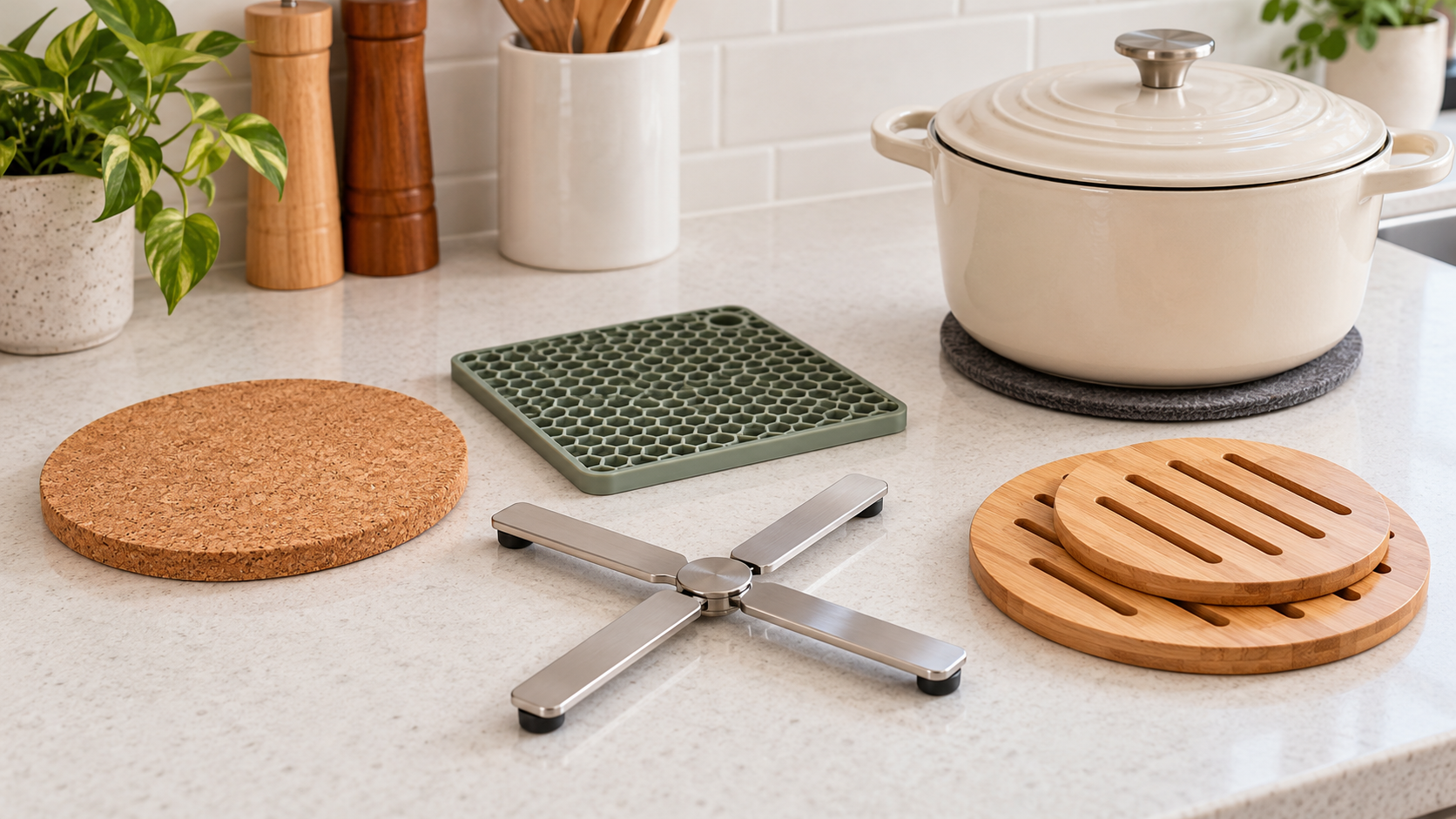
| Format | Potential fit | Check before buying |
|---|---|---|
| Flat cork | A simple lightweight landing pad that can store flat. | Diameter, thickness, material composition, cleaning method, and maker heat and surface wording. |
| Flat silicone | A washable flexible pad that may hang or roll for storage. | Usable area, openings, stated temperature limit, care, drying, and whether flexibility suits the cookware base. |
| Folding metal | A small stored footprint with a larger opened support pattern. | Opened span, contact points, feet, joints, setup, cleaning, and the maker's surface instructions. |
| Nested wood | Separate pieces that can support different cookware shapes and stack together later. | Each piece's dimensions, complete supported layout, finish, care, drying, and stored stack. |
Start with the cookware, not the trivet
Measure the base—not the rim or handle-to-handle width—of the pots, pans, serving dishes, or sheet pans that need a landing place. For irregular bases, note where the vessel actually makes contact. A trivet's outside dimensions do not prove that its supported area matches that contact pattern.
Then check the exact product's intended use. A listing should identify the material and provide relevant use, temperature, care, and surface instructions. Do not assume a decorative table mat, cooling rack, cutting board, towel, or generic silicone item is intended to receive the cookware in question.
Map the complete landing zone
On a compact counter, handles, lids, nearby appliances, cabinet doors, sink edges, and the route from the cooking surface all matter. Mark the proposed trivet outline with paper, then place a room-temperature empty pot on that mock-up. Make sure the cookware base is supported as directed and that handles do not project into a walkway, sink, flame, control, cord, or unstable edge.
A small stored product can still demand a large working area when opened. Record both dimensions. Two small trivets used together also require a repeatable spacing pattern; do not improvise a configuration the maker does not describe.
Read temperature and surface language narrowly
Temperature numbers are model-specific manufacturer statements, not a universal guarantee. Check whether the stated limit applies to direct cookware contact, an oven accessory, a pot holder, or another use. Also look for exclusions involving finished wood, stone, laminate, glass, painted surfaces, outdoor equipment, or prolonged contact.
A trivet does not make careless placement safe, and this guide cannot verify a particular counter or cookware combination. Follow the cookware, trivet, appliance, and counter-surface instructions together. If those instructions conflict or omit the intended use, choose another landing method approved for that setup.
Compare materials by upkeep and storage
- Cork: Check whether it is solid or composite, how the maker says to clean and dry it, and whether crumbling, staining, or moisture exposure is addressed.
- Silicone: Verify the material wording, stated limit, openings, edge shape, washing method, drying, and whether the flexible pad lies as the maker describes.
- Metal: Inspect the support points, feet, joints, edges, finish, cleaning access, and any surface-use restrictions. Metal construction alone does not establish counter compatibility.
- Wood: Check species or material disclosure when provided, finish, cleaning limits, drying, joints, segment spacing, and the maker's heat instructions.
Test storage before purchasing
Trace the product's stored dimensions on cardboard. Try the drawer, vertical slot, hook, or cabinet position where it would live. Include hinges, feet, raised ribs, hanging loops, and the thickness of a nested stack. A folding trivet only saves space if opening it is straightforward and its joints can be inspected and cleaned.
Keep frequently used landing equipment reachable before moving hot cookware. If the trivet will be buried behind pans or needs assembly in the middle of cooking, the storage solution may add more friction than it removes.
Run a room-temperature layout test
- List the cookware pieces that need a temporary landing spot during a typical batch-cooking session.
- Measure each base and trace the largest required supported area on paper or cardboard.
- Mock up the full counter position, including handles, lids, nearby tasks, and the travel path.
- Use only room-temperature empty cookware for the mock-up; do not test improvised materials with heat.
- Shop only if an intended-use product with clear maker instructions fits both the working and stored spaces.
When to skip a new trivet
- An intended-use trivet you already own fits the cookware, counter layout, and maker instructions.
- The counter has no clear landing zone away from edges, controls, cords, sinks, and other active tasks.
- The listing omits open or stored dimensions, material information, intended-use wording, care, or usable seller terms.
- The only support is a broad “heatproof,” “counter-safe,” “non-slip,” or “protects any surface” claim without specific instructions.
- The format needs a multi-piece arrangement the maker does not document.
- The product would be difficult to reach, inspect, clean, dry, or store before the next cooking session.
Keep the batch-cooking setup connected
If the real need is air circulation for baked food rather than a cookware landing zone, compare stackable cooling racks by pan fit, stated use, open height, cleaning, and storage. If sheet pans are consuming cabinet space between sessions, use the sheet-pan organizer guide. The broader routine-support tools guide keeps ordinary kitchen purchases tied to a specific recurring job rather than weight-loss promises.
Bottom line
For a compact batch-cooking counter, the useful trivet is the one whose supported area matches the cookware base, whose maker instructions match the intended use and surface, and whose complete working and stored dimensions fit the kitchen. Measure first, treat temperature and protection language narrowly, and skip listings that substitute broad claims for usable details.