Small-pantry buying guide
Best Under-Shelf Baskets for Meal-Prep Storage
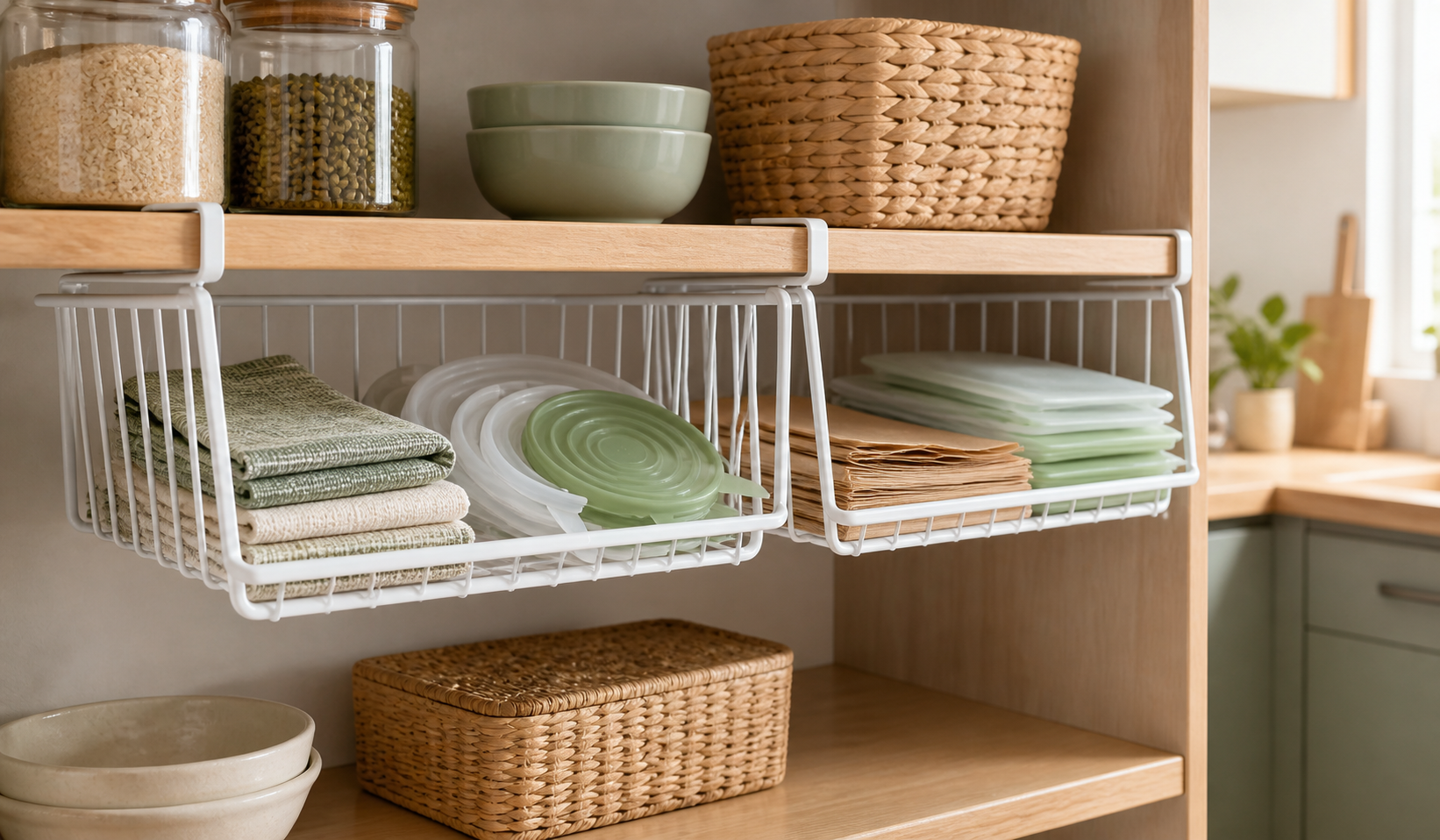
An under-shelf basket can turn an unused vertical gap into reachable storage for light supplies such as reusable bags, silicone lids, cloths, or parchment sheets. The useful choice is not the deepest basket—it is one that fits the shelf, clears everything below it, stays stable, and does not stop the cabinet door from closing.
As an Amazon Associate, GoodWeighFinds earns from qualifying purchases.
Who this guide is for
This guide is for adults with a sound cabinet or pantry shelf and an unused gap beneath it. It focuses on removable baskets for lightweight meal-prep supplies—not cookware, appliances, glass jars, heavy cans, permanent cabinet hardware, or food-storage advice.
For the broader low-hype decision path, start with the routine-support tools guide. If the problem is grouping items on the shelf rather than using the gap below it, compare pantry bins or lazy Susans for deep shelves.
Best-fit formats, not unsupported rankings
- Best fit for a standard removable shelf: A slide-on basket whose arms explicitly accommodate the measured shelf thickness.
- Best fit for folded supplies: A shallow, wide basket that keeps cloths, reusable bags, or paper products visible without a tall stack.
- Best fit for narrow cabinets: A single basket that leaves room beside it and does not conflict with hinges or shelf pins.
- Best fit for changing storage: A removable design that can be repositioned without drilling or adhesive.
- Best fit for simple upkeep: An open-wire or smooth-surface format with accessible corners and clear care instructions.
Selection criteria that matter
- Shelf-thickness fit: Measure the shelf at the actual installation point. Include any front lip, edge banding, liner, or bracket that changes the thickness.
- Basket width and depth: Check the cabinet's clear interior—not just the shelf board. Hinges, face frames, shelf pins, pipes, and door hardware can reduce usable space.
- Required clearance: Add the arm thickness, basket drop, and the height needed to place and remove the planned contents. Confirm that items below remain reachable.
- Attachment design: Compare the number, length, spacing, and shape of the slide-on arms. A published “universal” claim is not a substitute for dimensions.
- Load guidance: Follow the smaller of the basket maker's and shelf maker's limits, and keep the use lightweight. A claimed capacity does not guarantee that every shelf will resist sagging or tipping.
- Front lip or stop: A raised edge may help retain flat supplies, but it should not make them awkward to lift out.
- Door and hinge clearance: Test the full door swing and check whether the basket or its contents project into a hinge, frame, or latch path.
- Surface contact: Verify whether the arms have pads or coating and whether the maker gives guidance for painted, laminated, glass, or unfinished shelves.
- Cleaning: Open corners and removable installation make crumbs and dust easier to reach. Check the stated care method for coated metal or plastic.
- Return terms: Fit can be easy to misjudge, so confirm the current seller and return conditions before ordering.
A practical comparison framework
Mark each candidate yes, no, or unclear, then resolve every unclear item before buying.
- Does the stated arm opening fit the measured shelf thickness?
- Does the basket clear shelf supports, hinges, face frames, and the closed door?
- Will the loaded basket leave useful access to the shelf below?
- Are the planned contents lightweight, compact, and easy to remove?
- Is a load limit or other usable load guidance stated for the exact basket?
- Does the shelf itself remain stable and appear suitable for added off-center load?
- Can the basket and the surface above it be cleaned without dismantling the cabinet?
- Would rearranging the shelf height or using an existing bin solve the gap without another purchase?
Measure the installation, not the product photo
Write down four measurements: shelf thickness, clear cabinet width, usable shelf depth, and open height below the shelf. Then note the door, hinge, face-frame, and shelf-support positions. Product photos often show frameless cabinets with generous clearances; that setup may not match a face-frame cabinet or a shelf with a thick front edge.
Mock up the basket's outer dimensions with a small cardboard box before ordering. Open and close the door, reach past it to the shelf below, and remove the supplies you plan to store. This quick test reveals whether the extra tier creates useful access or merely moves the clutter.
Who should skip under-shelf baskets
Skip this category if the shelf is glass, visibly bowed, loose, damaged, unusually thin, or not approved for added load; if installation would press against a delicate finish; or if the basket would sit above a heat source, sink, or food-preparation area where falling items could create a problem. Use the cabinet or shelf maker's guidance when it is available.
Also skip listings that omit the arm opening, external dimensions, attachment method, or load guidance. Heavy cookware, small appliances, glass containers, canned goods, and other dense items belong in storage designed for their weight.
What an under-shelf basket cannot do
A basket can make a specific vertical gap more usable. It cannot strengthen a shelf, increase a cabinet's safe load, guarantee protection for every finish, keep food fresh, organize a poorly chosen mix of items, prescribe meal choices, or cause weight loss. Treat broad “healthy kitchen” claims as marketing rather than a demonstrated storage feature.
Bottom line
The best under-shelf basket for meal-prep storage fits the measured shelf and cabinet, leaves enough clearance to reach both tiers, states useful load guidance, and holds a defined group of lightweight supplies. Mock up the dimensions first, keep the load modest, and choose the smallest format that solves the actual gap.