Small-cabinet bottle storage guide
Best Vertical Water Bottle Organizers for Small Cabinets
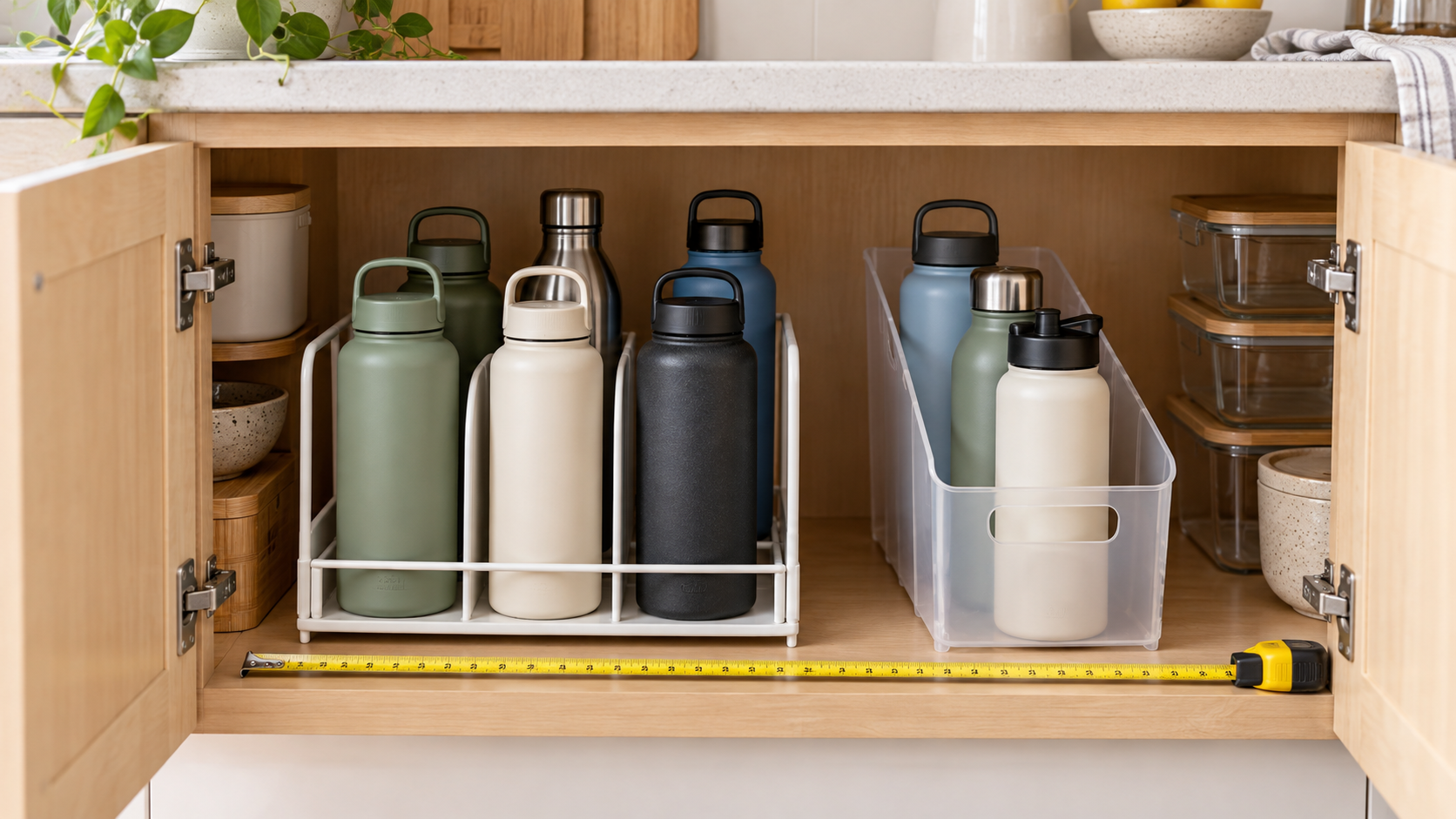
An upright organizer can help when empty reusable bottles topple, hide behind one another, or consume a whole cabinet shelf. The useful choice is the format that fits the actual bottles and cabinet—with enough clearance to lift each bottle out—not the organizer that advertises the largest capacity.
As an Amazon Associate, GoodWeighFinds earns from qualifying purchases.
Who this guide is for
This guide is for adults storing clean, empty reusable bottles upright in a narrow cabinet or pantry zone. It covers freestanding divided racks and open bins that separate or contain bottles. It does not cover bottle drying, wall mounting, refrigerator storage, filled-bottle transport, or horizontal wine-style racks.
For the broader buy-or-skip framework, start with the routine-support tools guide. If wet bottles and loose lids are the problem, compare bottle drying racks instead. If cabinet height is generous and you need another shelf for mixed items, a shelf riser may solve the real problem more directly.
Best-fit formats, not universal winners
- Best fit for mixed bottle diameters: An open bin with usable interior width that accommodates the widest bottle without wedging.
- Best fit for keeping bottles separated: A divided rack whose clear slot width matches every bottle body, sleeve, handle, and lid overhang.
- Best fit for deep shelves: A pull-forward bin with a reachable grip, provided its loaded length clears the cabinet door and hinges.
- Best fit for a stable existing lineup: No new organizer. A nonslip liner or fewer bottles may solve the toppling problem without consuming more space.
Measure the bottles before the organizer
Measure the widest point of each bottle, including silicone sleeves, side handles, lid loops, and flared bases. Record the tallest assembled height too. Product capacity labels such as “six bottles” are not useful unless the listing also gives clear slot or interior dimensions.
Then measure the cabinet opening—not just the shelf. Hinges, face frames, door hardware, shelf pins, and a narrower opening can prevent an organizer from entering even when the interior is large enough.
Selection criteria that matter
- Usable slot or bin width: Compare internal clearance with the widest stored bottle, leaving practical room for removal rather than relying on a tight nominal fit.
- Exterior footprint: Check full width and depth against the shelf, nearby items, face frame, and closing door.
- Lift-out clearance: Add the bottle height to the upward movement needed to clear dividers or bin walls. A shelf above can make a technically fitting setup unusable.
- Access direction: Decide whether bottles lift straight up, pull forward with the bin, or tilt past a front rail. Test that motion in the actual cabinet.
- Base and dividers: Look for documented assembly, level contact points, divider spacing, and any feet or liner. Do not infer stability from styled photos.
- Material and care: Follow the maker's cleaning instructions and inspect corners, seams, wire joints, and feet where dust or drips can collect.
- Loaded arrangement: Place taller or heavier empty bottles where they do not obstruct access. Do not exceed stated use or load guidance.
- Seller and returns: Confirm the current seller and return terms before assembly when fit cannot be established from complete measurements.
A practical comparison framework
Make a short list of every bottle that must fit, then eliminate any organizer without sufficient published dimensions. Sketch the loaded footprint on paper or mark it with removable tape inside the empty cabinet. Test the removal path with the tallest and widest bottles before comparing secondary details such as color or modular expansion.
For a divided rack, compare the smallest clear slot—not the organizer's total width. For a bin, compare internal taper and handle cutouts as well as the outside dimensions. A bin may contain bottles without keeping each one upright, while a divided rack may waste slots when bottle shapes vary.
Run a no-buy test first
Remove bottles that are damaged, rarely used, or missing compatible parts. Group the remaining empty bottles upright for one week using an existing narrow bin or shelf zone if appropriate. Note whether the problem is truly toppling, or whether excess quantity, wet storage, mismatched lids, or poor shelf access is causing the friction.
If reducing the set or relocating it fixes retrieval, a dedicated organizer adds cost and another object to clean. Buy only when a measured format improves a repeated storage task.
Use and care limits
Store bottles clean and fully dry according to their makers' directions. An organizer does not dry bottles, sanitize them, or make damp storage appropriate. Clean the organizer as labeled and allow it to dry before returning it to the cabinet.
Do not assume a countertop or cabinet organizer is suitable for a refrigerator, dishwasher, wall installation, or carrying filled bottles. Follow the exact product's stated use and assembly instructions.
Who should skip this purchase
Skip it when the cabinet opening or lift-out clearance is too tight, bottle sizes change often, an existing bin already works, or the collection can be reduced. Also skip listings that omit usable interior or slot dimensions, complete exterior dimensions, material, assembly details, or care directions.
Bottom line
The best vertical water bottle organizer is the one that fits the widest and tallest bottles, enters the real cabinet opening, leaves room for removal, and can be cleaned without fuss. Measure the collection and the full access path first; capacity claims and styled photos come later.