Routine-support buying guide
Best Shelf Risers for Meal-Prep Containers in Small Cabinets
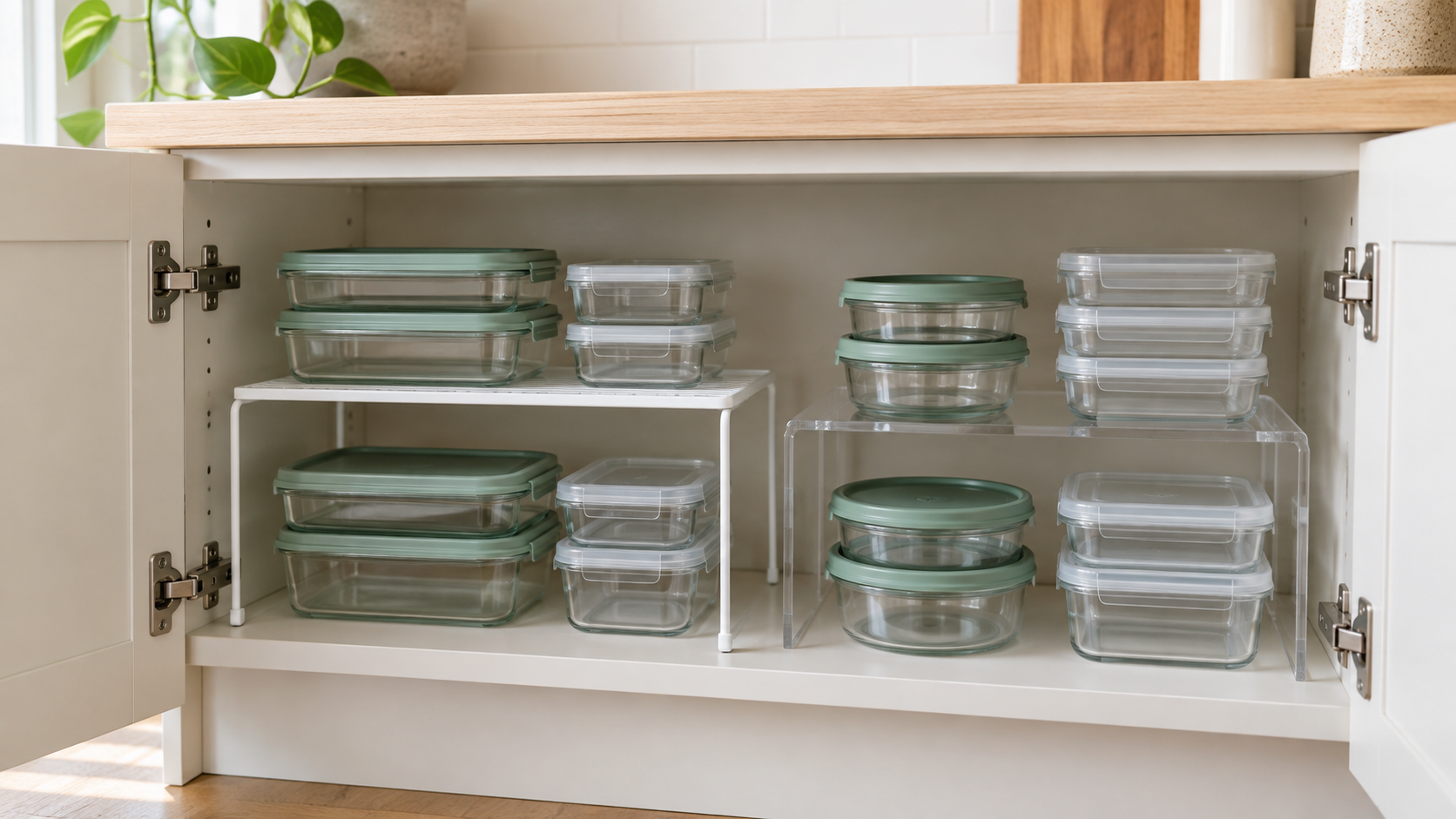
A shelf riser can turn one tall cabinet opening into two reachable levels, but it cannot create cabinet volume. The useful choice is the riser whose outside dimensions, space between its legs, top surface, and loaded access fit the containers and cabinet you already have.
As an Amazon Associate, GoodWeighFinds earns from qualifying purchases.
Who this guide is for
This guide is for adults whose empty reusable containers repeatedly form one hard-to-reach stack in a short kitchen cabinet. If you have not proved that a second level improves access, start with the shelf-riser buy-or-skip test. If loose lids are the actual problem, a measured container-lid organizer is the more relevant category.
For the site’s broader measure-first approach to ordinary routine tools, use the routine-support tools guide.
Useful formats—not ranked winners
- Fixed metal riser: A simple frame is easy to assess when one width and height fit. Check welds or joints, foot contact, top gaps, coating care, and the manufacturer’s load wording.
- Expandable riser: Adjustable width can fill a specific gap, but overlapping panels, braces, and the fully extended configuration can change usable space and stability.
- Clear acrylic riser: A transparent surface can keep items visible. Confirm thickness, edge shape, care directions, heat limits, foot design, and stated load rather than inferring strength from appearance.
- Maker-approved stackable riser: Use multiple tiers only when the current instructions explicitly support that assembly. Count the total height, joints, and access space in the proposed configuration.
Measure four spaces, not one
Record the cabinet’s usable opening width, depth, and height after accounting for hinges, face frames, door swing, shelf pins, and lips. Then measure four separate parts of the proposed setup:
- Outside footprint: Every foot must stand fully on a sound, level shelf without crossing an edge or hardware.
- Space below: Use the clear width and height between legs or braces, not the product’s overall dimensions.
- Top surface: Compare usable depth and width with the complete container stack, including lid latches and any overhang.
- Retrieval space: Leave enough height to grip, lift, angle, and return each container without dragging it against the shelf above.
Match the riser to the container routine
Measure the empty bases and lids you actually keep in rotation. A wide riser can be a poor fit if its legs split a common stack; a narrow one can waste side space or invite unsupported overhang. Put lighter, frequently used pieces at the easiest reach. Keep breakable or awkward stacks where they can be handled comfortably.
Test the layout with a cardboard mock-up while the cabinet is open, but do not use improvised cardboard as permanent loaded shelving. Retrieve the rear container, close the door slowly, and check whether the new level reduces shifting. If it creates two tighter stacks instead of two usable zones, the riser is not solving the problem.
Stability, assembly, and claim checks
- Stated load: Follow current maker guidance for the exact width and stacked configuration. Include the weight of containers and lids; do not infer capacity from photos.
- Feet and legs: Check that all feet contact the shelf and that caps or pads are attached as directed. A riser should not rock when one container is removed.
- Assembly: Confirm required fasteners, tools, locked positions, and whether disassembly is expected for cleaning or storage.
- Surface openings: Wire gaps, perforations, or panel seams must support the actual container base without tipping or catching.
- Care: Follow material-specific cleaning and drying directions. Treat rust resistance, scratch resistance, and stain resistance as claims rather than guarantees.
- Door clearance: Recheck knobs, latches, lid tabs, and front overhang with the cabinet closed.
When another setup fits better
A shelf riser separates levels; it does not make deep storage easy to pull forward. For deep shelves holding pantry items rather than container stacks, compare a stackable bin with a lazy Susan. An adjustable cabinet shelf may also solve the gap without adding another object, provided the cabinet maker’s supported positions and load instructions allow the change.
Before buying, match containers with lids, remove damaged or unused pieces, nest only compatible bases, and relocate occasional items. A smaller active set is often easier to reach than a larger set split across two levels.
Who should skip a shelf riser
Skip the purchase when the cabinet shelf is damaged or uneven, the feet cannot sit fully on it, the setup blocks hinges or doors, the listing omits usable dimensions, or the container stack would overhang. Also skip it when the added level puts glass or awkward items above a comfortable reach, or when simple rearrangement fixes the access problem.
Bottom line
The best shelf riser for meal-prep containers is the one that creates two genuinely reachable zones after every outside, inside, and retrieval dimension is checked. Choose a documented configuration, keep the load within maker guidance, and favor everyday access over the fullest-looking cabinet.