Buy, rearrange, or skip
Is a Shelf Riser Worth It for Meal-Prep Container Storage?
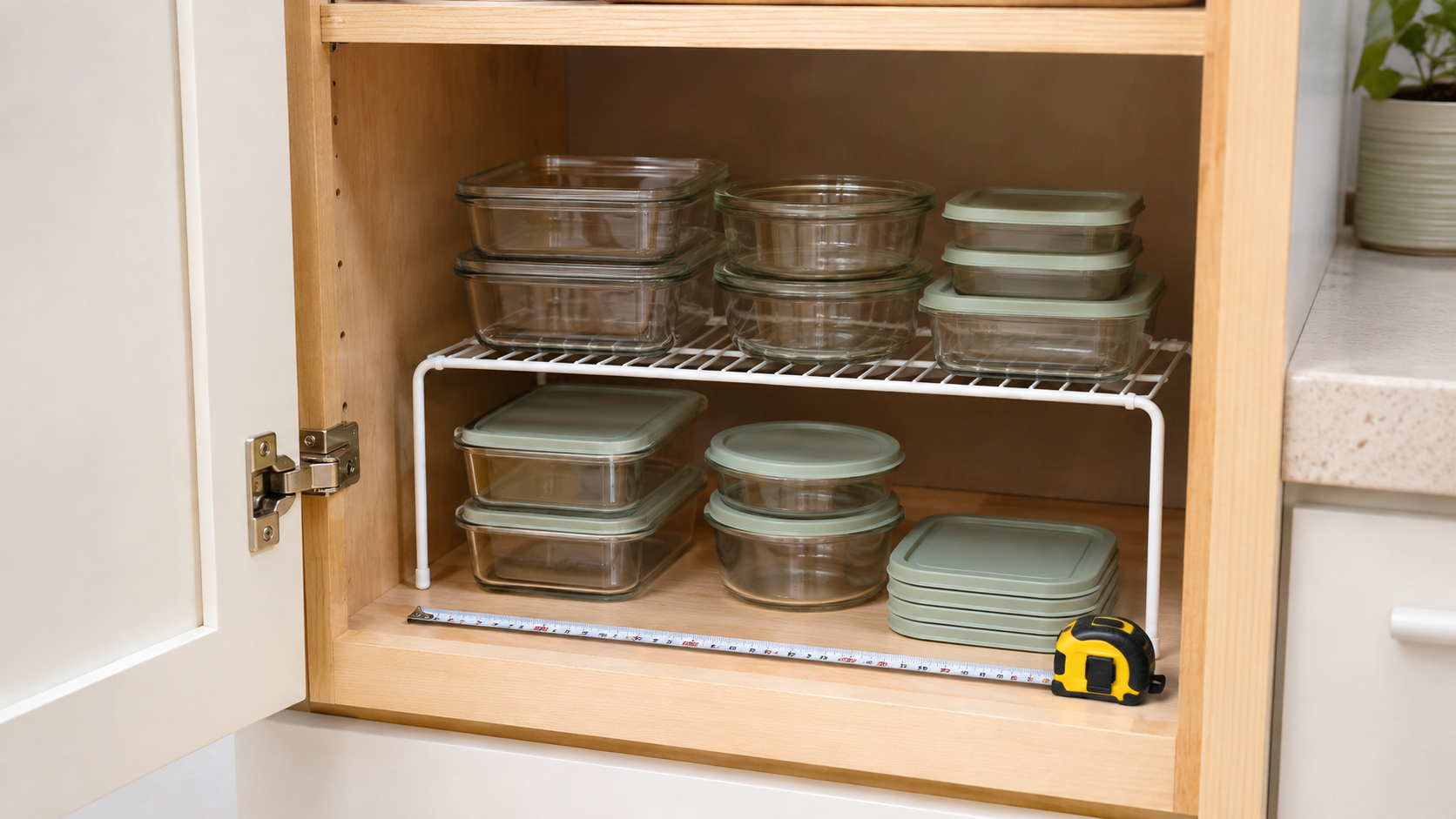
A shelf riser can be worth buying when a cabinet has unused height, containers are hidden beneath unstable stacks, and two shorter levels would make everyday pieces easier to reach. It is usually a poor fit when the cabinet is shallow, containers are tall, or mismatched lids—not vertical space—cause the clutter.
As an Amazon Associate, GoodWeighFinds earns from qualifying purchases.
The quick answer
- Likely worth it: the cabinet has a repeatable band of unused vertical space, your most-used containers fit on two accessible levels, and the riser can stand fully on a sound shelf.
- Rearrange first: empty containers and lids are mixed, rarely used pieces occupy the easiest reach zone, or a cardboard mock-up has not yet proved that a second level helps.
- Probably skip it: the riser would block the hinge or door, leave too little hand clearance, force heavy items overhead, or reduce useful depth.
Start with the problem, not the organizer
A riser solves one narrow problem: usable cabinet height exists, but stacking unlike items makes the lower ones difficult to reach. It does not create more cabinet volume. Its legs, frame, and top surface consume some of the space it divides.
First remove anything that does not belong in the cabinet, match containers with their lids, and move rarely used pieces elsewhere. If that fixes access, the no-cost arrangement is the better answer.
Run a cardboard test before buying
Use a sturdy empty box or an upside-down tray only as a temporary measuring mock-up while the cabinet is open; do not load it as permanent shelving. Set it where a riser might go and arrange the empty containers you actually use above and below it.
Try removing the container at the back and returning every piece without shifting the whole setup. Close the cabinet slowly and check the door, hinge, face frame, and any shelf supports. If the mock-up creates two genuinely usable zones, record its dimensions. If it only creates tighter stacks, skip the riser.
Six measurements decide the fit
- Usable opening width: measure between hinges, frames, and hardware—not only wall to wall.
- Usable depth: measure from the closed-door clearance line to the back wall, accounting for lips or shelf pins.
- Available height: measure to the shelf above, then subtract enough room to lift and angle containers comfortably.
- Space beneath the riser: use the listing's interior clearance, not its overall height. Legs and braces can narrow the opening.
- Container dimensions: measure the widest and tallest pieces in the group, including lids and latches.
- Reach clearance: confirm you can grip a container without scraping the shelf above or pulling several pieces forward.
Choose a format only after the test
Fixed-width risers
A simple fixed riser has fewer moving parts and is easy to assess if one width fits the cabinet. Confirm all feet sit on the shelf and that the top is wide enough for the intended containers without overhang.
Expandable risers
Adjustable width can fit changing groups, but the overlap may create an uneven surface or extra seams. Check the maker's adjustment range and load guidance for the exact configuration you plan to use.
Stackable risers
Stacking may use tall cabinets, but only when the listing explicitly supports that configuration and the assembled setup stays within stated limits. More tiers can make access worse and place heavier glass containers too high for a comfortable reach.
Stability and access checks
Place a riser only on a sound, level shelf and follow its assembly directions. Verify foot contact, frame movement, container overhang, and how the setup behaves when one container is removed. Do not infer a safe load from appearance; use the manufacturer's stated guidance and include the weight of the containers themselves.
Keep frequently used and easier-to-handle pieces in the most comfortable reach zone. A riser is not worth adding if it requires awkward lifting, blocks the door, or puts breakable containers where they can be pulled off an edge.
Cheaper alternatives to compare
- Separate containers and lids: Nest compatible empty bases and use a measured lid organizer when loose lids are the true bottleneck.
- Reduce the active set: Keep a practical rotation in the easy-reach cabinet and relocate occasional pieces.
- Use one shallow bin: A handled bin may help retrieve small lids or accessories, though it also consumes space and must fit the shelf.
- Adjust an existing shelf: If the cabinet has supported shelf positions, the maker's instructions may allow a better height without another product.
What a shelf riser cannot do
A shelf riser can separate stored equipment; it does not improve food quality, determine suitable portions, or cause weight loss. It also cannot correct damaged lids, containers used outside their labeled temperature or appliance limits, or a cabinet shelf that is not suitable for the intended load.
Bottom line
A shelf riser is worth it only when a measured second level makes frequently used containers easier to retrieve without sacrificing door, hand, or load clearance. Rearrange first and prove the layout with a temporary mock-up. If that test supports buying, compare shelf-riser formats by outside fit, usable clearance, stability, assembly, and access. For the broader approach, use the routine-support tools guide.