Pull-forward storage or rotating access
Stackable Pantry Bin vs Lazy Susan for Deep Shelves
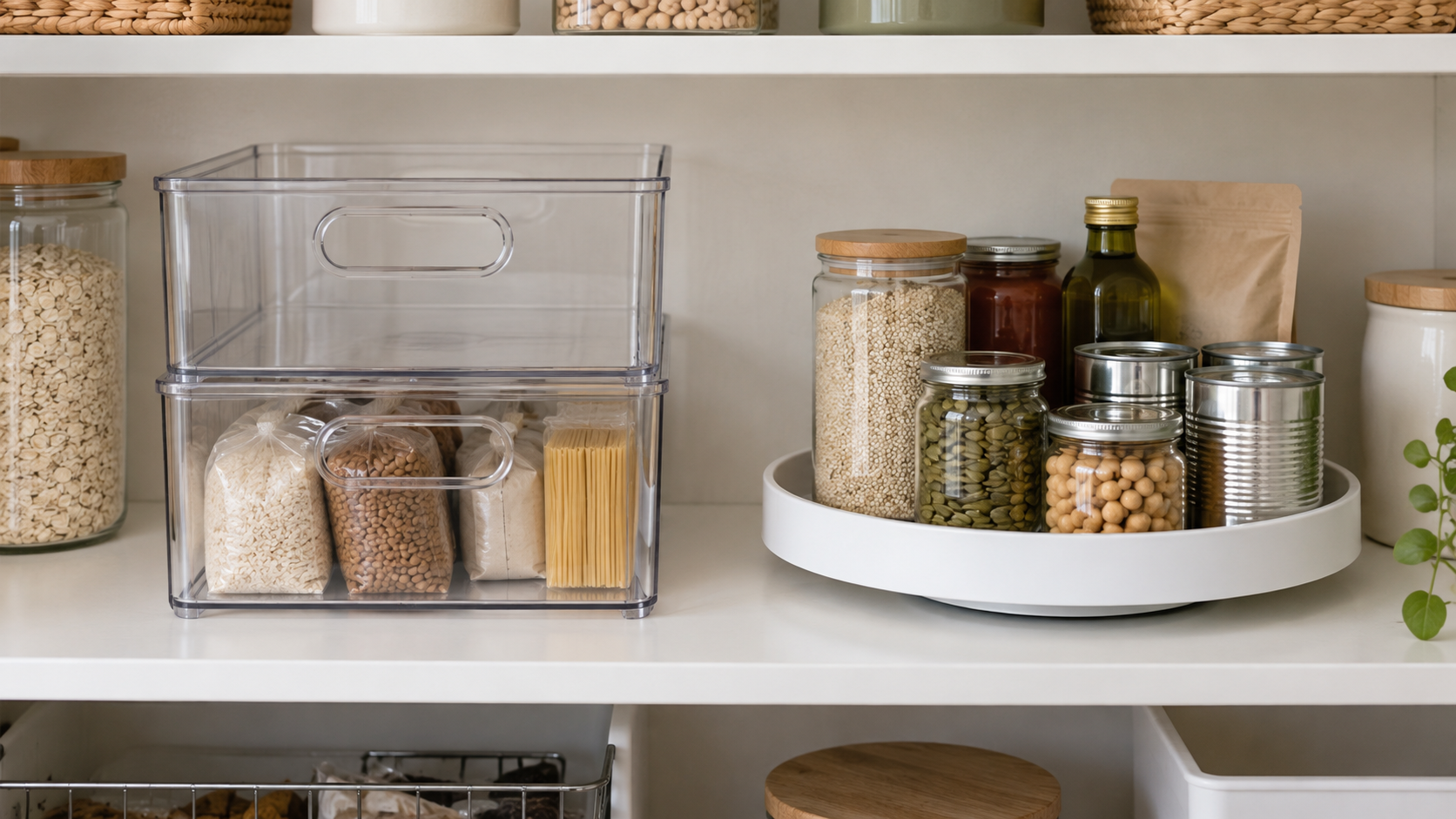
Choose a stackable pantry bin when you want to group similar items, use vertical space, and pull the whole group forward. Choose a lazy Susan when several small or medium items need individual access without reaching behind the front row. Neither format fixes a shelf it cannot physically fit.
As an Amazon Associate, GoodWeighFinds earns from qualifying purchases.
The quick comparison
- Stackable bin: better for packets, backup goods, or a category you usually retrieve together; less convenient when a heavy upper bin must be moved to reach the lower one.
- Lazy Susan: better for individually selected jars, cans, and bottles; it sacrifices the shelf corners and needs open space above and around the load to rotate.
- Use neither: when moving the front row, reducing duplicates, or assigning a simple shelf zone already makes everything reachable.
Measure the shelf as a working space
Record the usable width, depth, and height after accounting for door hinges, shelf lips, brackets, and the items on the shelf above. Then mark each organizer's listed footprint with paper or tape. Product dimensions do not always describe usable interior space, so compare the inside measurements of a bin and the usable platform diameter inside a turntable rim.
For a turntable, leave room for the widest loaded item to sweep a full circle without striking a wall or neighbor. For stacked bins, include the handles, lid or nesting features, and enough overhead room to lift or pull the intended bin without scraping the shelf above.
Choose by the motion you can repeat
A bin makes the back of a deep shelf accessible by moving an entire category toward you. That works best when the load remains manageable and the handle can be reached. A turntable keeps its base in place and rotates items forward, which can suit shelves where lifting a loaded bin would be awkward.
Test the motion with an empty tray or box before buying. If the shelf is high, neither a heavy pull-out bin nor a turntable crowded with tall breakable containers may be a sensible access plan. Reassign frequently used or heavier items to a shelf you can reach and handle comfortably.
Where each format loses space
- Bins: sloped sides, handles, dividers, and stacking hardware can reduce usable volume. A stack may also turn the lower bin into hidden storage.
- Turntables: a circular platform leaves unused shelf corners. Tall items near the edge may need more surrounding clearance than the platform diameter suggests.
- Mixed sizes: neither format is automatically efficient when tiny packets sit beside large containers; grouping by use may matter more than matching organizers.
- Visibility: clear material helps only when labels face outward and the organizer is not overfilled.
Cleaning and spill containment
A removable bin can carry a whole category to the counter and may contain a small dry-goods spill, but deep corners and handle seams still need cleaning. A turntable can expose items without unloading the shelf, yet raised rims, bearings, and nonslip surfaces may collect crumbs or residue. Follow the care directions for the exact organizer; do not assume every clear plastic piece is dishwasher safe.
For oils, syrups, or other leak-prone containers, check whether the base is solid and whether it can be lifted level. An organizer should not be treated as a substitute for closing, inspecting, or cleaning the containers stored on it.
A practical decision rule
- Pick a stackable bin if the measured shelf has safe vertical clearance, the grouped load stays easy to move, and you regularly pull several related items at once.
- Pick a lazy Susan if you want one-at-a-time access, the loaded circle can rotate freely, and losing the shelf corners is an acceptable tradeoff.
- Combine cautiously only when separate shelf zones fit without blocking each other; do not place a turntable on top of a pull-out bin.
- Skip the purchase if a one-week reset—removing expired goods, facing labels forward, and moving frequent items to the front—solves the problem.
Compare models only after choosing the format
Once the motion and shelf geometry are clear, use the pantry-bin guide for handle, interior, stacking, cleaning, and label criteria. Use the lazy Susan guide for platform diameter, rim height, rotation clearance, base, and care checks.
Bottom line
A stackable bin is the stronger fit for moving a category and using measured vertical space; a lazy Susan is the stronger fit for rotating individual items forward. Measure the loaded motion, not just the empty footprint, and start with a shelf reset before buying. For the broader buy-or-skip approach, see the routine-support tools guide.