Small-entryway walking-gear storage
How to Choose Wall Hooks for Walking Gear in Small Entryways
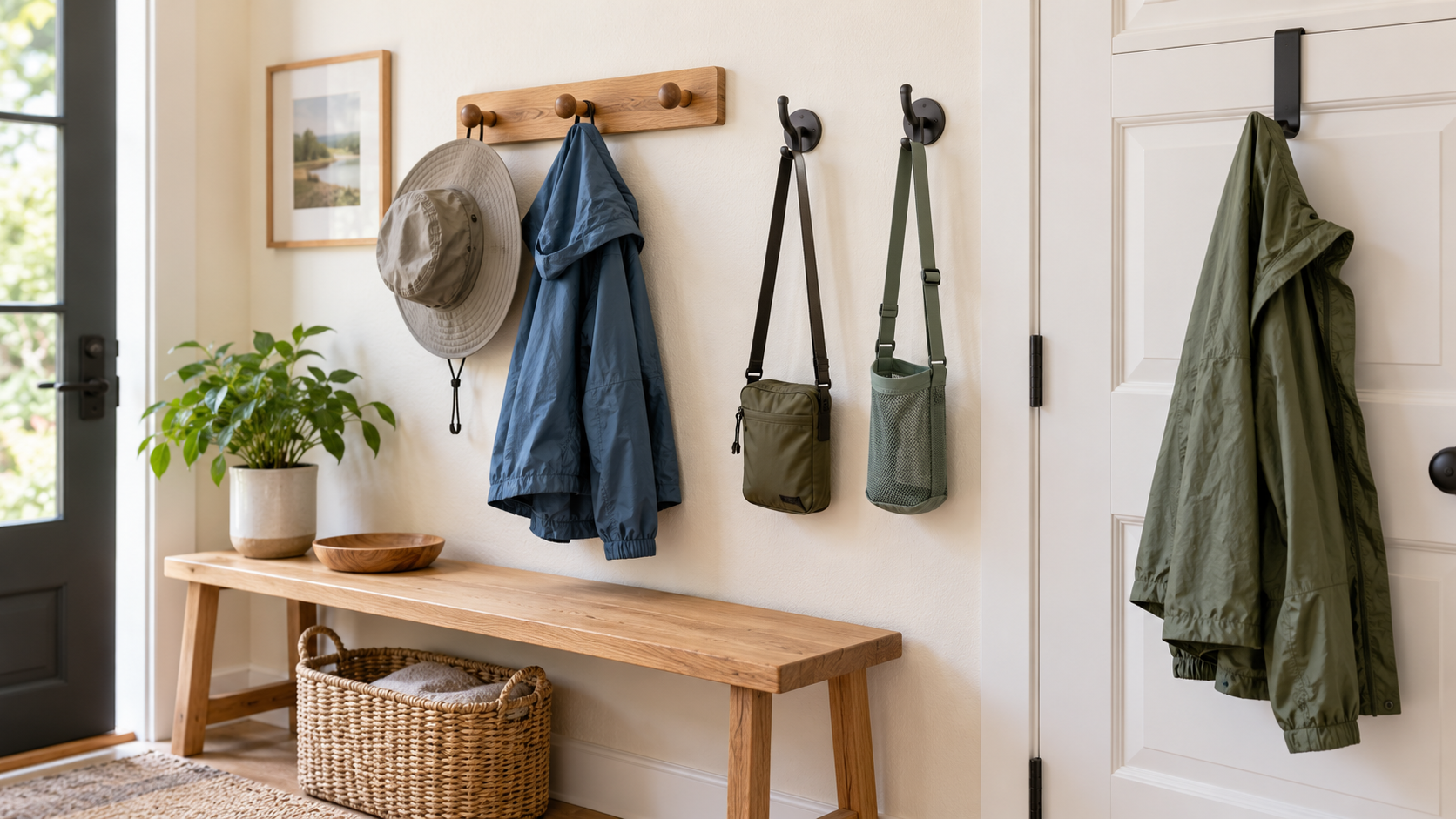
A useful hook keeps the hat, light layer, sling, or empty day bag you actually take on walks within reach. The right format depends on the wall or door, the gear's loaded weight, the mounting instructions, and whether hanging items will obstruct a doorway or walking path.
As an Amazon Associate, GoodWeighFinds earns from qualifying purchases.
Start with the gear, not the hook
Lay out what routinely needs a home: perhaps a hat, packable shell, empty sling, reflective accessory, or small day bag. Weigh the items in the condition they will be hung. A bag that is usually loaded with a bottle, keys, or groceries creates a different decision from an empty pouch.
This guide is for ordinary lightweight walking accessories. Shoes, wet footwear, heavy backpacks, mobility equipment, and anything overhead or safety-critical need storage designed and installed for that exact job. For wet shoes and floor-level cleanup, use the shoe rack versus boot tray comparison.
Compare the formats
| Format | Useful when | Check first |
|---|---|---|
| Hook rail | Several small items need predictable spacing in one zone. | Rail length, hook spacing, fastener positions, stud or anchor requirements, and loaded clearance. |
| Individual mounted hooks | The wall has awkward spacing or gear needs different heights. | Hook projection, screw pattern, mounting surface, included hardware, and installation instructions. |
| Over-door hook | Drilling is not suitable and the door has adequate top and side clearance. | Door thickness, gap above the door, frame contact, closing clearance, and item swing. |
| Existing knob or freestanding rack | No new mounting is needed and the current setup stays clear of movement paths. | Whether it interferes with the door, crowds the floor, or encourages overloading. |
Verify the mounting system
“Wall mounted” does not identify a compatible surface. Read the maker's directions for drywall, studs, masonry, tile, wood, or another named surface. Confirm whether fasteners are included and whether they are intended for your wall. Adhesive mounting is a separate system with its own surface preparation, curing, removal, temperature, and load directions; do not translate “removable” into a promise of no paint or surface damage.
A stated load is not a universal real-world result. It can depend on correct hardware, wall condition, installation, load direction, and how the item sits on the hook. Stay within the exact instructions and do not use a light-duty organizer for support, climbing, hanging exercise equipment, or any purpose where failure could injure someone.
Measure the loaded footprint
- Width: Mark the full rail or hook spread on the wall, including room to lift gear off.
- Projection: Add the hook depth to the thickest hanging item. A jacket or bag can project much farther than the hardware.
- Height: Put daily items within comfortable reach without creating head-level obstacles.
- Door swing: Test the open and closed path, handle access, hinges, and the way hanging items move.
- Walking path: Keep straps, cords, buckles, and dangling accessories away from feet and narrow passageways.
Match the hook shape to the item
A broad rounded peg may suit a hat loop or jacket collar better than a narrow edge, while a deeper upturn may retain a strap more reliably. Double hooks can separate two light items, but only if their combined load and bulk fit the product instructions. Product photos are not measurements: compare the stated opening, projection, and width with the actual straps and loops at home.
A hook can crease a hat, press a jacket's fabric, or concentrate weight on a thin strap. Check the gear maker's storage guidance where available. Empty a bag before hanging it if the contents create excessive weight or change the balance.
Run a no-purchase layout test
- Gather the exact gear that needs storage and weigh the likely combined load.
- Use removable paper outlines to mark a rail or several hooks on the proposed wall; do not treat the paper as a load test.
- Include the hanging length and depth of every item.
- Open the entry and closet doors fully, walk the route, and check switches, trim, vents, and bench access.
- Buy only if the measured layout solves a repeated problem and the mounting instructions suit the surface.
When to skip wall hooks
- An existing closet, shelf, basket, or freestanding rack already keeps the gear visible and reachable.
- The listing omits dimensions, mounting directions, supported surfaces, stated load, or usable return terms.
- You cannot identify a suitable mounting surface or install the hardware as directed.
- The only workable spot blocks a door, switch, walkway, or comfortable reach.
- The gear is wet, heavy, sharp, valuable, or safety-critical enough to require a different storage system.
- A renter or household agreement does not permit the required installation.
Keep the routine connected
If the storage problem is an errand bag rather than walking accessories, compare reusable grocery-bag organizers for small entryways. For deciding what walking accessories are worth organizing in the first place, the routine-support tools guide keeps the focus on practical friction rather than weight-loss promises.
Bottom line
The best wall hook is not the one with the largest advertised number. It is the format whose mounting instructions match the actual surface, whose shape fits the gear, and whose loaded footprint stays clear of doors and walking paths. Measure first, keep loads modest, and skip the purchase when an existing storage spot already works.