Small-entryway storage guide
How to Choose Reusable Grocery-Bag Organizers for Small Entryways
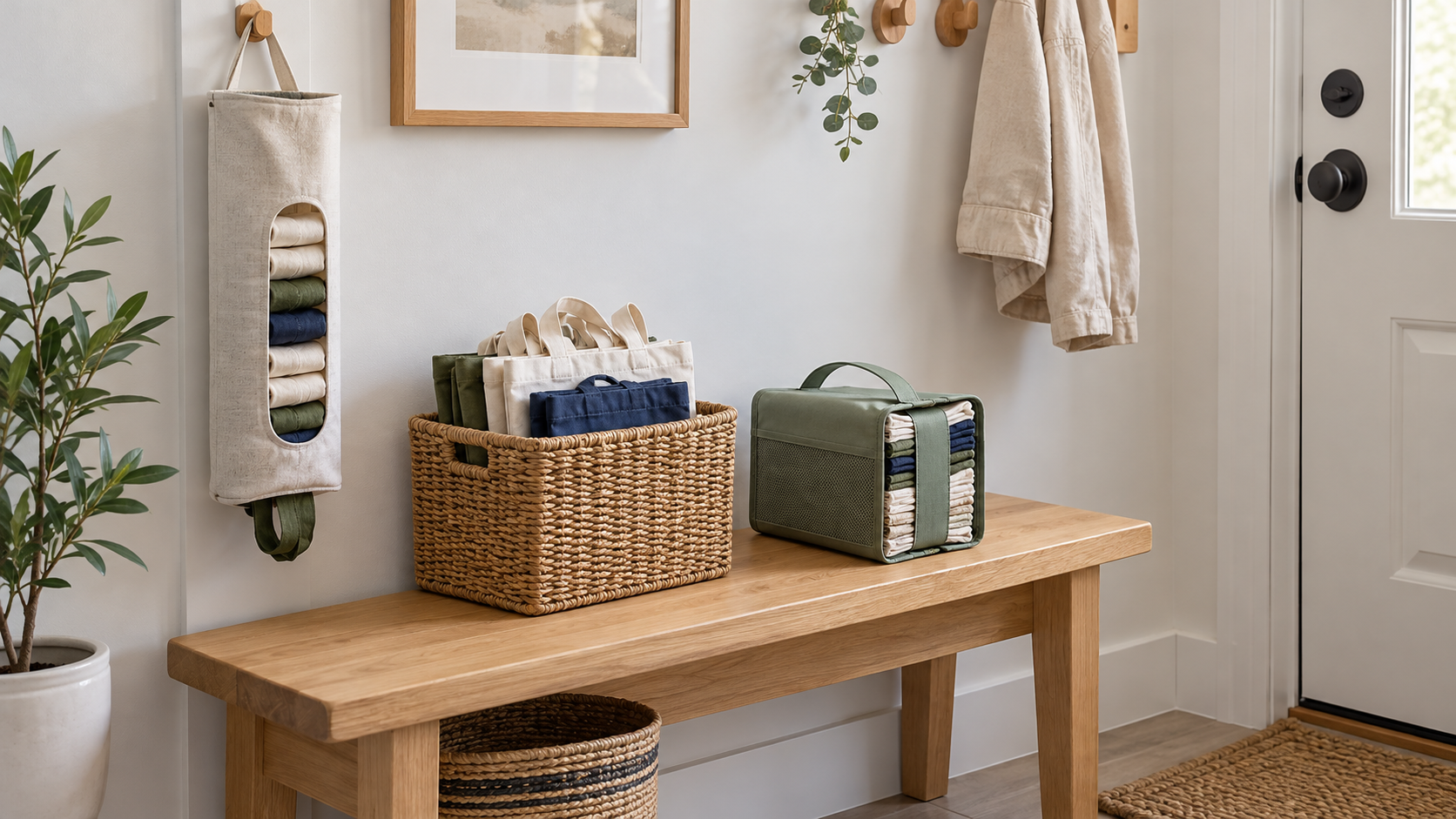
The useful organizer is the one that keeps clean shopping bags visible and easy to return to your errand kit without blocking a door or consuming the whole entry bench. Start with the bags you actually keep, then choose a holder that fits their folded shape and your available wall, door, shelf, or floor space.
As an Amazon Associate, GoodWeighFinds earns from qualifying purchases.
Count and sort the bags before shopping
Empty the current bag stash and keep only clean, usable bags that have a recurring job. Separate rigid box bags, flexible totes, compact self-stowing bags, and insulated bags. They do not occupy the same space or dispense through the same opening.
If the real decision is which bags to carry rather than where to store them, use the reusable grocery bags for transit guide or the packable tote guide first. This page covers storage between trips, not bag performance at the store.
Four organizer formats to compare
| Format | Potential fit | Verify before buying |
|---|---|---|
| Wall-mounted fabric dispenser | Flexible totes folded or rolled into a narrow vertical holder | Loaded depth, fill and access openings, supported wall and fasteners, stated load, removal, and wash care |
| Over-door holder | Households avoiding a dedicated patch of wall | Door thickness, hook depth, top and side clearance, hinge movement, closure, noise, and contact points |
| Open bin or basket | Mixed bag shapes that need quick drop-in access | Inside and outside dimensions, handles, shelf or floor fit, snag points, cleaning, and path clearance |
| Portable caddy | A small bag set moved between entryway, car, cart, or closet | Bag fit, closure, handle, full dimensions, empty weight, cleaning, and whether another tote already works |
These are storage formats, not ranked winners. A holder that works for thin fold-flat totes may not fit rigid or insulated bags, and “large capacity” does not replace usable dimensions.
Selection criteria that matter
- Loaded dimensions: Measure width, height, and depth with the intended bag set inside. Include protruding handles and a hand-access zone.
- Bag compatibility: Check the opening against the folded width and thickness of each bag type. Do not assume rigid bags will compress.
- One-step return: Choose a format people can refill after unloading groceries. A complicated folding rule can turn the bench back into storage.
- Door and walking clearance: Open the door fully, test coat and shoe traffic, and keep the organizer out of the required path.
- Mounting details: Verify the supported surface, hardware, stated load, instructions, and removal method. Treat “damage free” as a product claim, not a guarantee.
- Cleaning and drying: Bags should be clean and dry before storage. Check whether the organizer is washable, wipeable, or spot-clean only.
- Retrieval: A dispenser should release one bag without pulling out the stack. An open bin should expose the needed bag without being emptied.
- Seller and returns: Confirm the exact dimensions, included parts, seller, and current return terms before ordering.
A five-minute entryway fit check
- Fold the bags the way your household will realistically store them.
- Stack that set and measure its width, height, and depth.
- Mark the proposed footprint with removable paper or tape, following the surface maker's directions.
- Open nearby doors fully, walk through with a normal grocery load, and reach for one bag.
- Reject any location that blocks movement, hides the bags, or makes refilling awkward.
This mock-up tests the workflow without relying on a staged listing photo. It may reveal that an existing basket, hook, shelf, or tote already solves the problem.
Claims and limits to check
Capacity counts can depend on unusually thin bags or tight folding. “Heavy duty,” “space saving,” “easy install,” and “damage free” need exact dimensions, materials, supported surfaces, hardware, stated loads, and instructions. None proves the organizer will fit your bags or wall.
A grocery-bag organizer is a routine-maintenance tool. It does not improve nutrition, create a shopping habit, or cause weight loss. Its useful role is modest: giving clean reusable bags a consistent place between trips when the format fits the household.
Who should skip this purchase
Skip a dedicated organizer when the bag set already fits in one existing tote, drawer, hook, or basket; when bags are rarely returned to the entryway; or when the only location interferes with a door or walking path. Reduce an oversized bag stash before buying storage for it.
If hats, light layers, and walking accessories are the items that need a landing spot, use the wall-hooks guide for lightweight walking gear instead of turning a grocery-bag holder into a general entryway organizer. For a broader framework, use the routine-support tools guide. If carrying several bags is the harder problem, compare a compact cart with reusable bags instead.
Bottom line
The best reusable grocery-bag organizer is the smallest format that holds the clean bags you genuinely reuse, fits the loaded entryway location, and makes return and retrieval simple. Measure first, verify installation and care details, and reuse an existing container when it already works.