Small-kitchen storage guide
How to Choose Wrap Dispensers for Foil and Parchment in Small Kitchens
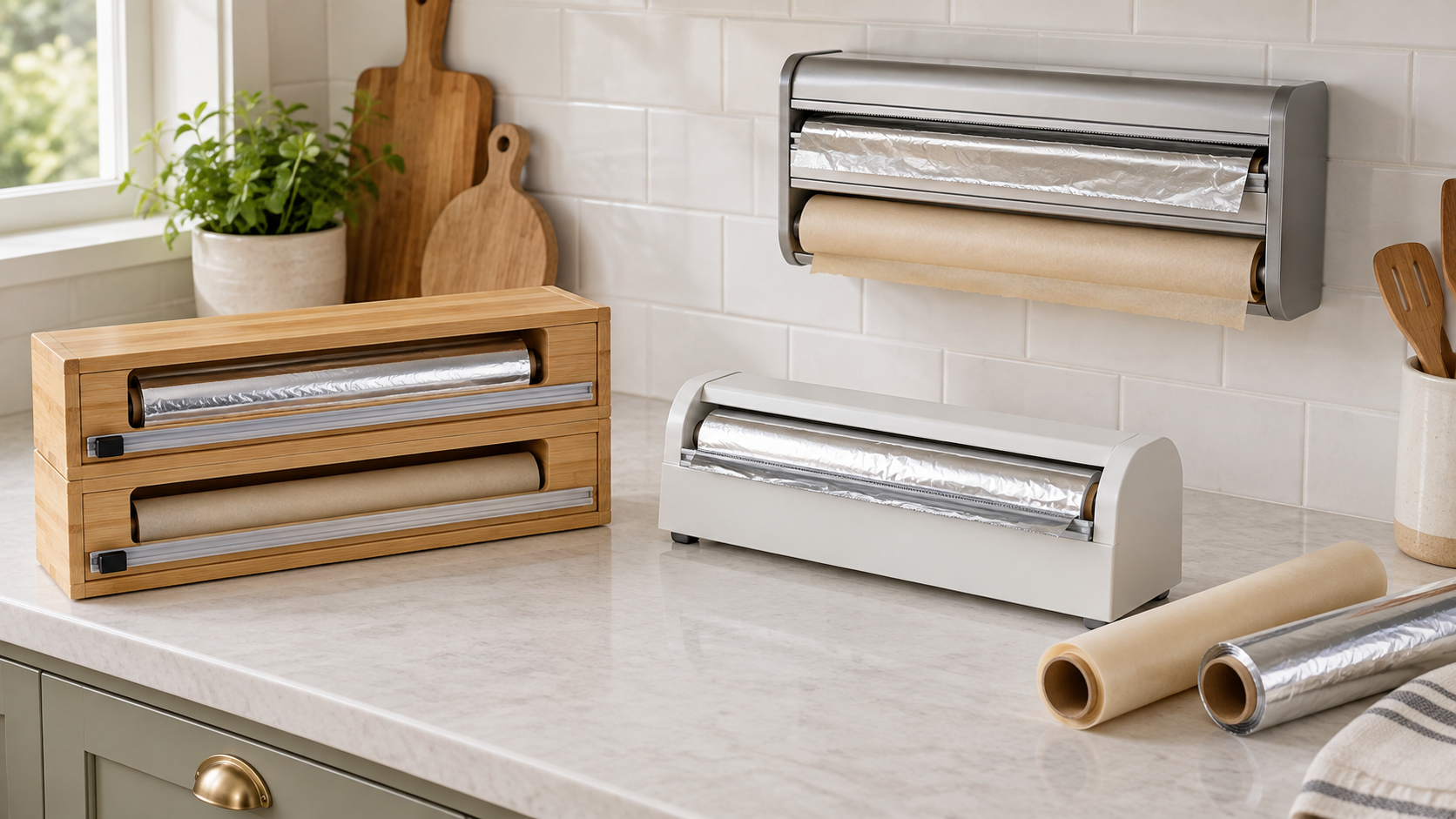
A wrap dispenser is useful only when the rolls fit, the cutter works in your chosen location, and refilling it is easier than using the original boxes. Start with measurements and workflow—not a coordinated drawer photo.
As an Amazon Associate, GoodWeighFinds earns from qualifying purchases.
Quick answer: the best format fits both the roll and the motion
| Format | Potential fit | Verify first |
|---|---|---|
| Drawer dispenser | You want the rolls hidden and have a drawer wide, deep, and tall enough for the loaded unit. | Interior drawer dimensions, loaded height, handle clearance, roll width and diameter, and cutter access. |
| Countertop dispenser | You use wrap often and can dedicate stable counter space near the prep area. | Base footprint, movement during use, feed direction, refill access, and how the cutter is guarded. |
| Wall or cabinet-mounted dispenser | Drawer and counter space are scarce, and an approved mounting surface is available. | Fasteners or adhesive instructions, surface exclusions, door and appliance clearance, loaded projection, and removal directions. |
| Original roll box | You use wrap occasionally or the current box already stores and dispenses it adequately. | That a separate organizer would solve a repeated problem rather than add refilling and cleaning. |
Measure the rolls you actually buy
“Standard roll” is not a useful measurement. Record the full roll width, core size, and outside diameter before removing any packaging. If a listing gives only overall dispenser dimensions, it has not established that your roll will fit inside.
- Measure each unopened or recently opened roll from end to end.
- Measure the largest outside diameter you expect to load.
- Check whether the roll uses a removable core support, spring rod, or open cradle.
- Compare the dispenser's stated internal limit—not just its exterior width.
- Confirm that the cutter and feed path match foil, parchment, or plastic wrap as explicitly stated by the maker.
Do not assume one cutter geometry handles every material equally, and do not force a roll into a compartment that the maker does not list for it.
Check the complete operating space
- Drawer clearance: Include the loaded dispenser, labels, handles, cutter tabs, and the hand motion needed to pull and cut a sheet.
- Counter footprint: Mark the base with paper or tape and test whether it conflicts with the cutting board, appliance doors, or routine cleaning.
- Mounted projection: Measure how far the loaded unit extends and whether cabinet doors, switches, outlets, or nearby appliances need that space.
- Refill path: Check whether the unit opens from the top, end, front, or back and reserve enough clearance to remove the roll support.
- Label visibility: If two materials share a unit, choose labels you can read in the installed position; do not rely on appearance alone.
Cutter and mounting claims need specifics
Words such as “clean cut,” “one-hand use,” “universal,” “damage-free,” and “strong hold” are claims, not measurements. Look for maker instructions showing the intended material, cutter position, pull direction, installation surface, preparation, fasteners, cure time, load conditions, and removal method.
A concealed slider or guarded edge may fit your household better than an exposed serrated edge, but the listing still needs clear use instructions. Keep any cutting edge away from children and from places where hands reach without looking. If you need a formal safety feature or accessible setup, do not infer it from staged photos.
Cleaning, refilling, and replacement checks
- Material and finish: Read the maker's exact description; bamboo-style appearance does not establish solid bamboo, moisture resistance, or long-term durability.
- Care instructions: Check whether the body, cutter track, labels, and removable parts are wiped, hand-washed, or otherwise maintained.
- Debris access: Look for corners and cutter tracks where torn paper or foil fragments could collect.
- Replacement parts: Verify whether a cutter slider, blade cartridge, roll support, label, or mounting hardware has a documented replacement path. Treat current availability as temporary.
- Refill friction: A dispenser that requires several parts to be removed may not suit frequent roll changes.
A simple no-buy test
For one week, keep the original boxes in the proposed drawer, countertop spot, or mounted-height zone. Note how often you use each roll, whether the box slides, whether the cutter is awkward, and whether access conflicts with another task. If the original boxes work and the main problem is visual clutter, a shallow bin or a different shelf may solve it with less refilling.
Skip or delay the purchase when
- The listing omits internal roll limits, loaded dimensions, cutter instructions, or mounting requirements.
- Your usual rolls vary in width or diameter and the dispenser does not document that range.
- The only available drawer is too shallow or the mounted location interferes with doors, heat, moisture, outlets, or appliance instructions.
- An exposed cutter position would be a poor fit for the household.
- You expect the unit to prevent injury, protect a countertop, make food safer, or improve nutrition; an ordinary dispenser does not establish those outcomes.
- The original boxes already dispense and store the rolls without recurring friction.
Keep the purchase tied to a real prep bottleneck
If cabinet storage is the larger problem, compare sheet-pan organizers for narrow cabinets by measured slot and loaded clearance. If flexible baking surfaces are the decision, use the silicone baking mat versus parchment guide. For a broader way to choose practical kitchen tools without body-result promises, start with the routine-support tools pillar.