Write the details or turn one compact marker
Food-Storage Label vs Date Dial for Leftover Tracking
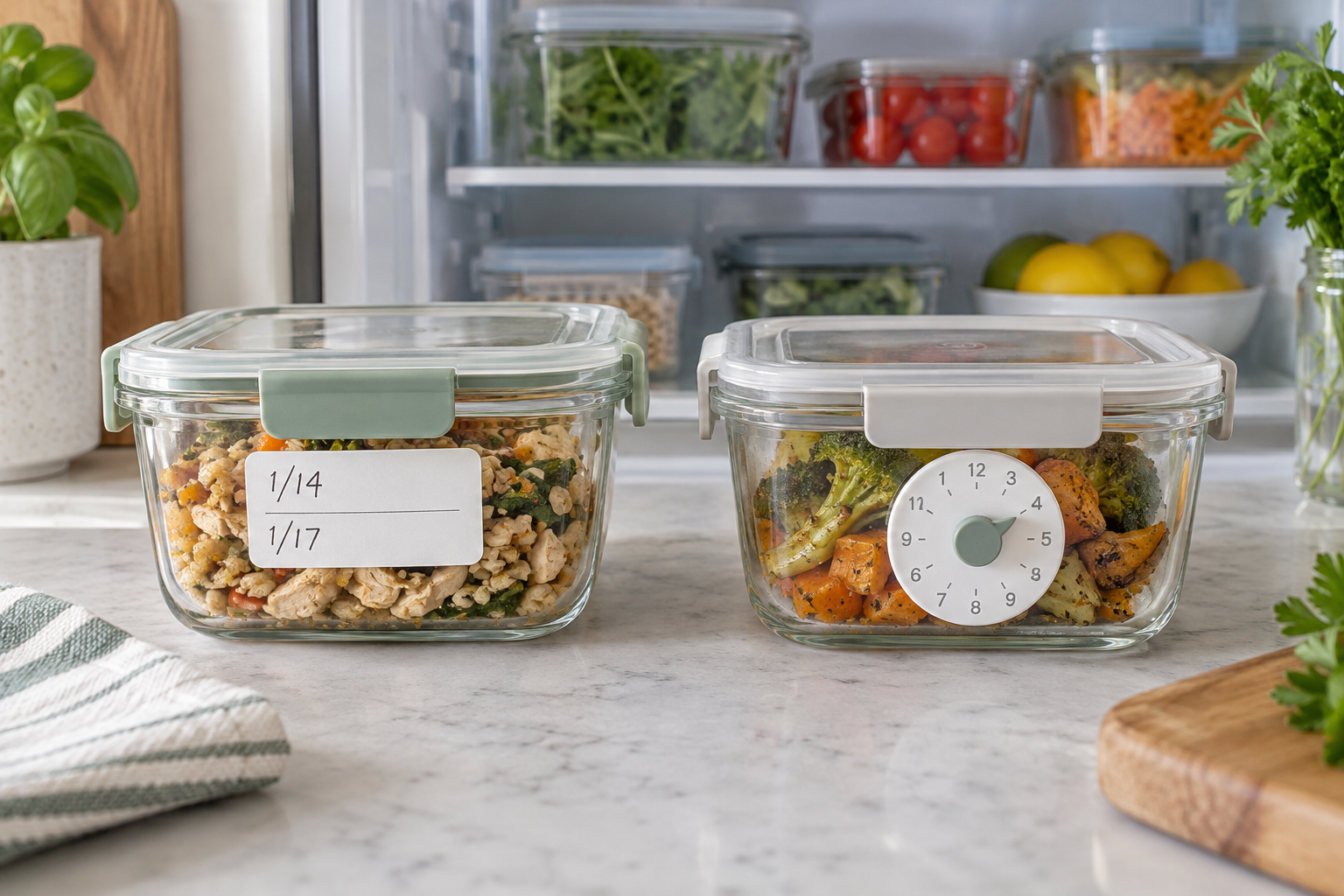
A writable label can record the food, date, and another short detail. A reusable date dial usually records one date in less space. The better fit depends on what your household needs to know, which containers you use, and whether writing, resetting, washing, and finding the marker will actually happen.
As an Amazon Associate, GoodWeighFinds earns from qualifying purchases.
The quick comparison
| Decision | Writable label | Reusable date dial |
|---|---|---|
| Information | Can record a food name, date, and short note | Usually communicates one selected date |
| Routine step | Find a label and suitable pen, then write | Attach the marker and turn or set it |
| Container fit | Needs a clean, suitable flat writing area | Needs a compatible clip, band, suction point, magnet, or dedicated lid feature |
| Reset | Remove, erase, or replace according to the product | Turn to the next date after cleaning |
| Best fit | Mixed foods or shared kitchens where context matters | A repeat system where the date alone is enough |
Who a writable food-storage label fits
A label fits households that need to distinguish similar containers or record more than a date. A sufficiently large writing area can hold a brief food name, the date stored, or a simple use-first note. That extra context can matter when several people share a refrigerator or freezer.
Measure the available flat area on the smallest container you intend to label. Check the listed surface compatibility, pen type, temperature limits, and removal or erasing instructions. “Removable” and “residue free” are product claims, not guarantees for every lid material, finish, temperature, or storage duration.
Who a reusable date dial fits
A date dial fits a repeat container routine where one visible date is enough and writing feels like unnecessary friction. The marker may be integrated into a lid or attach with a clip, band, magnet, or other mechanism, so compatibility matters more than the dial's appearance.
Check the complete date range, numeral size, pointer alignment, attachment dimensions, and whether the marker must be removed before washing, reheating, freezing, or stacking. A loose separate marker can be easy to misplace, while an integrated dial may tie the system to one container set.
Tradeoffs that change the decision
- Information depth: choose writing space when people need to know what the food is or why a date matters; choose a dial only when everyone understands the date convention.
- Readability: judge the real viewing distance, handwriting space, contrast, numeral size, and refrigerator lighting rather than relying on enlarged listing photos.
- Container mix: labels can span several compatible containers; a dial's attachment may work only with one lid, rim, or container family.
- Upkeep: labels require a supply or an erase-and-dry step. Dials require resetting, cleaning around moving or attachment points, and keeping parts together.
- Failure mode: a label can peel or leave residue; a dial can be bumped to another date or detached. Verify claims and consider what an unnoticed failure would mean for your routine.
Setup and maintenance
Before buying, run a one-week test with masking tape and a pen. Write only the information your household actually checks. If the food name and date both prove useful, a label has the clearer job. If everyone uses only the date and the writing step gets skipped, simulate a dial with a reusable clip or removable token and confirm where it would attach.
Follow the exact product and container directions for application, washing, freezing, reheating, and removal. Clean and fully dry reusable markers as directed before resetting them. Keep spare labels and the matching pen together, or give separate dials one consistent storage point when containers are empty.
Claims and limits to verify
“Freezer safe,” “dishwasher safe,” “waterproof,” “residue free,” “reusable,” and “universal fit” are seller or manufacturer claims unless documented for the exact item and use. Check materials, compatible surfaces, temperature and appliance instructions, care steps, included quantity, and current return terms. Customer anecdotes can suggest questions but do not prove adhesion, durability, or compatibility.
A marker records information; it does not determine whether food is safe to eat. Follow applicable storage guidance and discard food when its identity, handling, or storage history is uncertain. Neither format preserves food, prevents spoilage, improves nutrition, or produces weight-loss results.
Who should skip each format?
- Skip writable labels when the container has no compatible flat area, the household will not keep the pen nearby, or date-only information is sufficient.
- Skip a date dial when food names or instructions are necessary, the attachment does not match every intended container, or small numerals and controls are difficult to read or turn.
- Skip both when containers already have a reliable built-in marking system or a simple dated shelf zone handles the small number of leftovers.
- Use a broader system when the real problem is losing track of many freezer packages; a central inventory board may be more useful than adding a marker to every container.
Bottom line
Choose writable labels when the household needs names, dates, or short context across a mixed set of compatible containers. Choose date dials when one date is enough and a verified attachment fits the repeat container system. Skip both if a no-buy test shows that an existing pen-and-tape routine or shelf zone already works. Next, compare food-storage label formats, review date dials and reusable markers, or consider a freezer label versus central inventory board for larger batches. This comparison supports the routine-support tools pillar.