Shared-pantry label comparison
Label Maker vs Handwritten Labels for a Shared Pantry
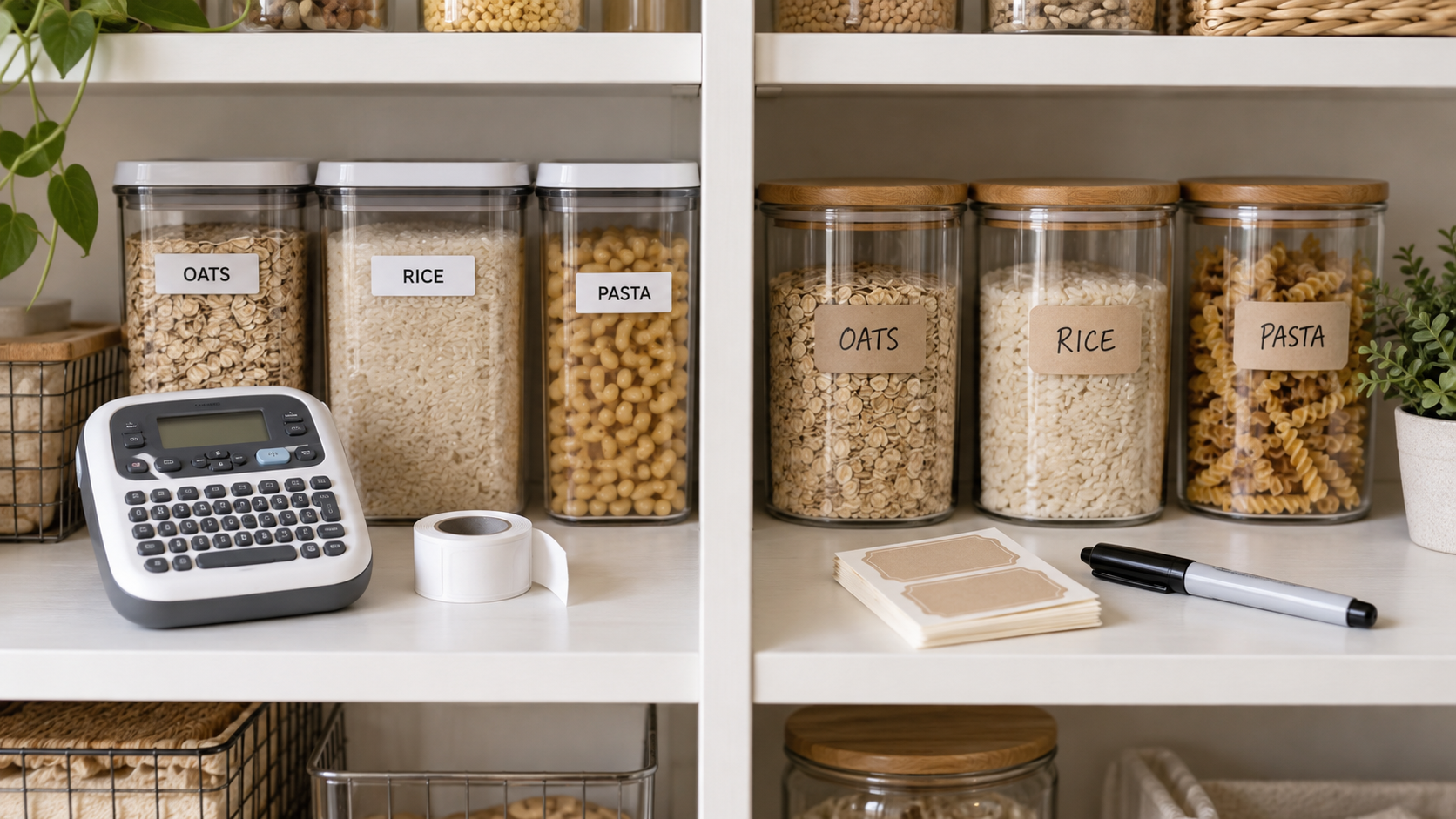
A label maker trades setup, power, and proprietary refills for repeatable printed text. Handwritten removable labels are cheaper to try and quicker to change, but their usefulness depends on legible writing and a label-and-marker routine everyone can maintain. Neither method organizes a pantry by itself.
As an Amazon Associate, GoodWeighFinds earns from qualifying purchases.
Quick decision: which method fits?
| Decision | Label maker | Handwritten removable labels |
|---|---|---|
| Up-front setup | Device, power or batteries, compatible tape, and a short learning curve | Labels plus a marker that writes clearly on them |
| Ongoing supplies | Device-specific tape or cartridges | Replacement labels and usable markers |
| Readability | Consistent type when text size and contrast are suitable | Depends on handwriting, marker tip, space, and contrast |
| Fast changes | Requires the device and matching refill to be available | Write a new label immediately if supplies are nearby |
| Shared use | Can standardize labels, but everyone must be able to operate it | Easy to understand, but writing styles may vary |
| Best no-buy test | Borrow one or test existing printed labels first | Use paper cards or labels already in a drawer |
Choose a label maker when consistency solves a real problem
A label maker fits a shared pantry when printed text is materially easier for household members to read, many labels use the same format, and someone will keep the correct refill available. Physical-key models avoid phone setup; app-connected models may offer more layouts but add account, permission, charging, and software-support questions. The broader label-maker buying guide compares those formats without naming an unsupported winner.
Before buying, check the smallest and largest text the device can print on the selected tape width. Confirm the exact tape family, cartridge length, color contrast, power source, and whether common editing tasks work on the device itself. Price the device and several realistic refills together. A low device price does not make a system inexpensive if compatible tape is difficult to identify or routinely unavailable.
Choose handwritten labels when flexibility matters more than uniformity
Handwritten removable labels fit a pantry that changes often, needs only a modest number of labels, or is still testing where items belong. They require no device, cable, batteries, app, or proprietary tape family. A plain card can also be moved before any adhesive is committed to a shelf or container.
The tradeoff is variation. Test the actual marker and label together: a thick tip can crowd a small label, a pale ink can disappear at a distance, and cursive or compressed writing may not be accessible to every reader. If several people write labels, agree on a few plain words rather than creating a complicated naming system. “Rice” is usually easier to maintain than a category hierarchy nobody remembers.
Measure and test the surface before choosing supplies
Neither printed nor handwritten text fixes a label that is too small, hidden by a shelf lip, or poorly matched to its surface. Measure the usable flat area on the shelf edge, bin, or container. Check whether the current product documentation names that surface and gives conditions for application and removal. Treat “removable,” “water-resistant,” “freezer-safe,” and “residue-free” as product-specific claims, not guarantees.
Test one label in an inconspicuous spot for the period that matters to your routine, then remove it according to the maker’s directions. Do not assume the same adhesive behaves identically on painted wood, unfinished wood, plastic, glass, metal, or a textured basket. If the unresolved question is where the label should live, use the separate shelf-edge versus container-label comparison.
Setup and maintenance tradeoffs
Label-maker setup
- Confirm that the device, tape width, and cartridge family match before opening supplies.
- Choose one readable text size and high-contrast tape combination for the first small batch.
- Store the device and spare tape where more than one household member can reach them.
- If the device uses an app, review current account requirements, permissions, export options, and whether printing still works when the phone or app changes.
- Keep the old label in place until the replacement is printed so a temporary setup does not become an unidentified container.
Handwritten-label setup
- Test marker legibility on the chosen label size before applying a full set.
- Keep the marker with the labels; separating them adds avoidable friction.
- Use short, familiar wording and enough blank space for easy reading.
- Replace a label when its meaning changes instead of crossing out text until it becomes ambiguous.
- Clean and dry the surface only as directed by the label and container makers.
Who should skip each option?
Skip the label maker if the pantry needs only a few labels, compatible refills are unclear, no one wants to maintain another device, or an app/account would make printing dependent on one person. Also skip it when paper cards, a marker, or labels already owned are readable enough.
Skip handwritten adhesive labels if household members cannot reliably read the writing, the relevant surface is not supported, or the labels are repeatedly changed without old ones being removed. A reusable card holder or a simple shared pantry note may fit better.
Skip labeling altogether when the pantry is small and obvious, contents remain in clearly marked original packaging, or the household frequently rearranges shelves. Labels that are not updated can be less useful than no system.
A low-cost trial before buying a device
- Choose one stable pantry zone with five to ten items.
- Write the plainest useful names on paper cards or removable labels already owned.
- Ask every household member to locate and return items for a week.
- Note the actual failure: hard-to-read writing, labels in the wrong place, changing categories, or nobody maintaining the system.
- Buy a label maker only if consistent printing addresses that observed failure and the refill routine is acceptable.
If the larger issue is whether fixed pantry zones will last, use the shared-pantry shelf-label buy-or-skip test. For the broader context, the routine-support tools pillar keeps product choices tied to a specific household task rather than body-result promises.
Bottom line
Choose a label maker when consistent, accessible print is worth the device setup and refill commitment. Choose handwritten removable labels when a low-cost, easy-to-change system is more likely to be maintained. Start with one pantry zone, verify the exact surface and supply claims, and keep whichever method everyone can read and update without unnecessary friction.