Rotate jars or pull the group forward
Refrigerator Turntable vs Handled Bin for Condiments
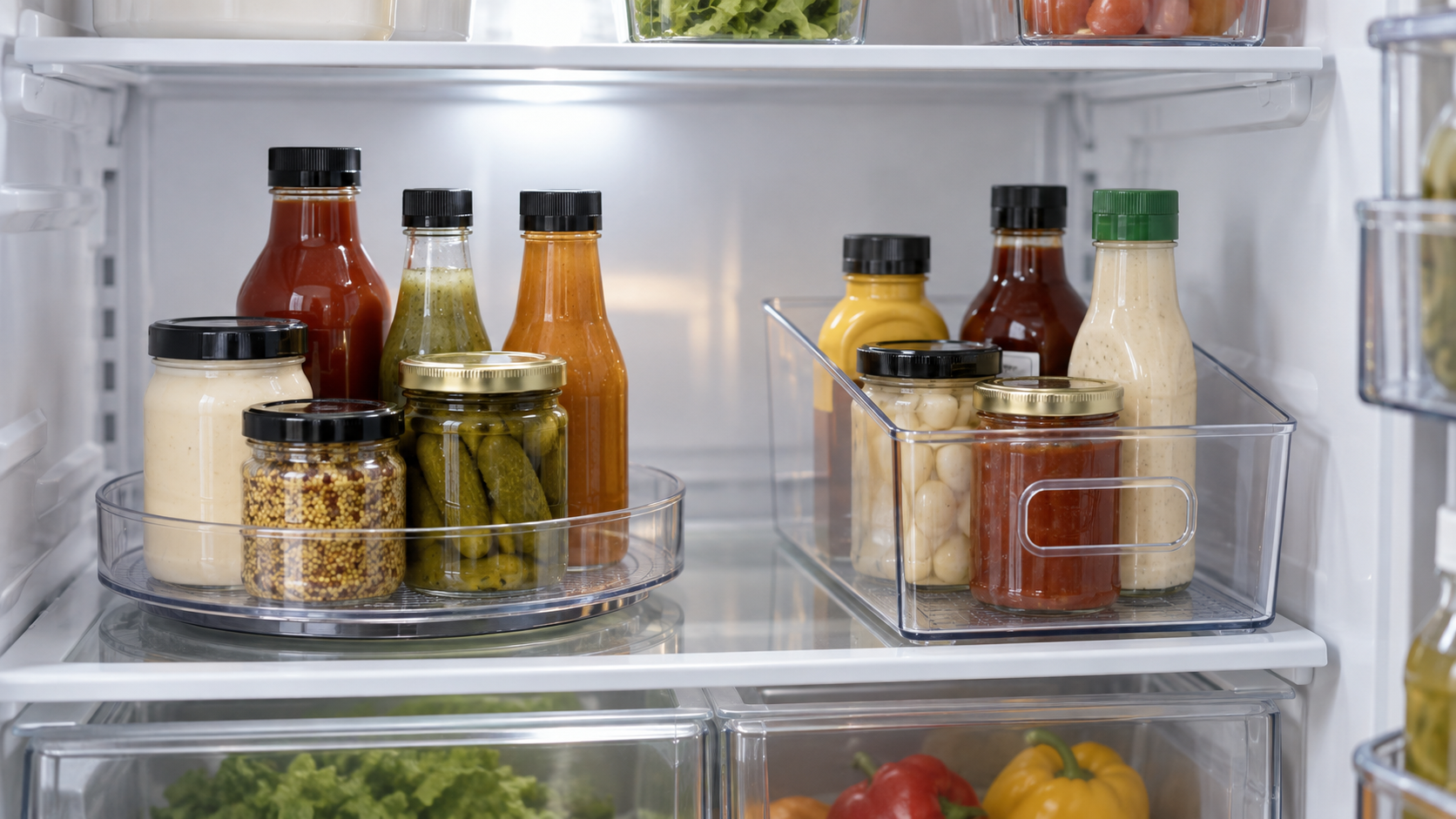
A turntable brings jars around a circle. A handled bin moves a whole rectangular group toward you. The better format depends on the shelf, door swing, container shapes, reach, and whether you usually need one condiment or the entire group.
As an Amazon Associate, GoodWeighFinds earns from qualifying purchases.
The quick comparison
| Decision | Turntable | Handled bin |
|---|---|---|
| Access motion | Rotate one item to the front | Pull the group forward, then lift an item |
| Shelf shape | Round footprint leaves corners unused | Rectangular footprint can use shelf depth |
| Best item mix | Upright jars and bottles that remain visible around the rim | Packets, short jars, or a category that moves together |
| Clearance | Needs room to turn and lift items over the rim | Needs a clear pull-out path and reachable handle |
| Upkeep | Tray, rim, and rotating base | Interior corners, handle, and shelf contact area |
Who a turntable fits
A refrigerator turntable can fit a deep shelf where individual jars disappear behind one another and the full circle can rotate without touching a wall, door bin, or neighboring container. It is most useful when you want one item at a time and labels stay visible while the tray turns.
Measure the complete outside diameter, usable area inside the rim, loaded height, and lift-out clearance. A round tray gives up the shelf corners, and a high rim can hide short jars. The rotating base also adds height that product photos may not make obvious.
Who a handled bin fits
A handled bin can fit a rectangular shelf where condiments form one useful group and there is a clear path to pull that group forward. It can work well for packets, short jars, or bottles that would be unstable or hard to see on a rotating edge.
Measure the outside width, depth, and height as well as the usable interior after wall taper and handle space. Check whether the loaded bin can pass the door, hinge, and shelf lip. A bin that technically fits but must be fully unloaded to move is not solving the access problem.
Run a paper-and-box test before buying
Cut a paper circle to a candidate turntable's listed outside diameter. Arrange the usual jars within it and rotate the paper through a full turn. Then use a small box or existing container as a stand-in for the bin. Pull it forward with the refrigerator door partly open, as it would be during normal use.
Count the steps required to retrieve and return one common item. Notice lost corner space, blocked labels, handle reach, top clearance, and any door-bin collision. If moving the most-used jars to the front solves the problem, skip both products.
Setup and maintenance tradeoffs
- Turntable: leave full rotation clearance, avoid crowding jars against the rim, and inspect how the rotating base should be cleaned and dried.
- Handled bin: preserve the pull-out path, avoid loading it beyond the maker's guidance, and confirm the handle remains reachable when the shelf is full.
- Both: verify that the exact product is described for refrigerator use and follow its stated hand-wash or dishwasher directions.
- Spills: remove the organizer and clean all surfaces according to the maker's directions; neither format prevents leaks or makes food last longer.
- Routine reset: return items to the same group only if that grouping remains useful. An organizer should not become a place where expired or forgotten jars stay hidden.
Claims and details to verify
“Fits most refrigerators,” “non-slip,” “smooth rotation,” “heavy duty,” and “easy to clean” are seller or manufacturer claims unless supported for the exact item and setup. Use measurements and care directions instead of treating those phrases as universal facts. Customer anecdotes can suggest questions, but they do not establish capacity, durability, safety, or performance in your refrigerator.
Neither organizer changes the food itself, guarantees better habits, or produces weight-loss results. Its limited job is to change visibility, grouping, or retrieval on one shelf.
Who should skip each format?
- Skip a turntable when the shelf is shallow, the door bin overlaps the circle, tall bottles are top-heavy, or the round footprint wastes needed rectangular space.
- Skip a handled bin when the loaded group would be too awkward to pull, the handle sits out of reach, or shelf and door geometry block removal.
- Skip both when the shelf is already easy to scan, the usual jars fit in a visible front row, or an existing tray completes the same job.
- Choose another approach when the real issue is repeated spills, unclear dates, or too many duplicate condiments; an organizer does not fix those problems by itself.
Bottom line
Choose a turntable for one-at-a-time rotating access when the full circle and lift-out path fit. Choose a handled bin when a rectangular group needs to move forward together and the loaded pull path stays clear. Skip both if a front-row reset works. For format details, use the refrigerator turntable guide; for the broader buy-or-skip decision, see whether fridge organizers earn their space. This comparison supports the routine-support tools pillar.