Batch-cooking format comparison
Sheet-Pan Divider vs Separate Sheet Pans for Batch Cooking
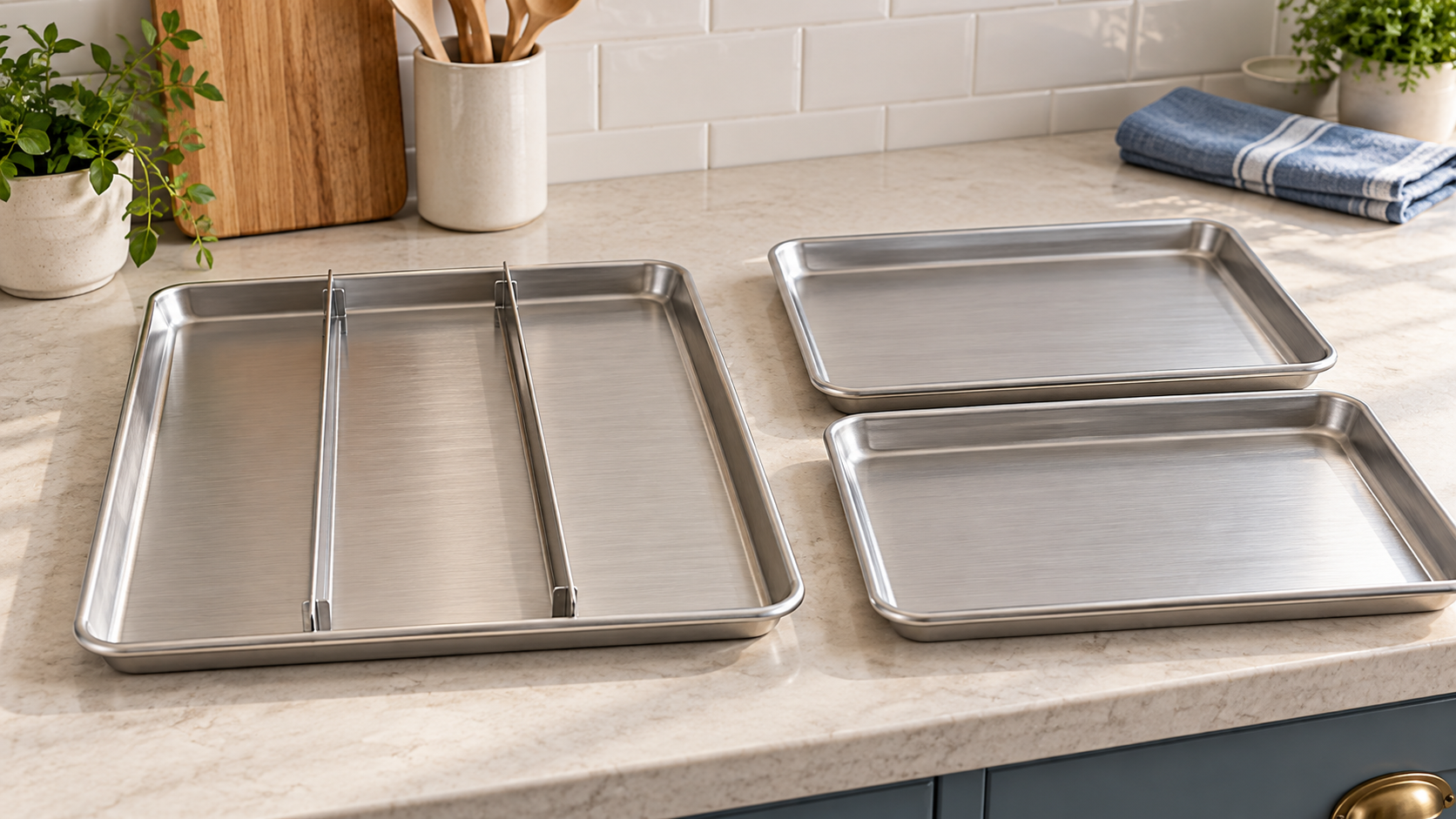
Use a divider when one compatible pan fits the oven and the foods can share one handling schedule. Use separate pans when the batches need independent placement, removal, or cleanup. Measure the full setup first: neither format guarantees even cooking, prevents cross-contact, or makes batch cooking healthier.
The short answer
A divider fits a one-pan workflow. It keeps one outer pan to lift, wash, and store, but the insert consumes usable area and every section moves in and out together.
Separate pans fit independent batches. They can be placed or removed separately, but only if the pans, rack, oven, landing space, washing area, and cabinet can accommodate them.
If your current pan plus folded foil or two oven-safe dishes already demonstrates the layout you need, skip the specialized divider.
What each option actually changes
| Decision | Divider or insert on one pan | Separate sheet pans or trays |
|---|---|---|
| Oven and rack fit | One outer-pan footprint, plus the divider's height and attachment clearance | The combined footprints and the clearance required around each pan |
| Usable area | Reduced by divider walls, rims, gaps, or handles | Spread across each pan; may require more rack or counter area |
| Batch timing | All sections share one pan movement unless inserts are designed for separate removal | Each pan can move independently when the recipe and oven instructions allow |
| Handling | One loaded outer pan; check total loaded weight and grip clearance | More individual lifts and more hot items needing safe landing space |
| Washing and drying | Outer pan plus divider parts, seams, edges, or attachment points | More large pan surfaces but fewer specialized joints |
| Storage | Divider must nest, stand, or lie somewhere without obstructing the pan stack | Each pan needs a measured slot or stack; an organizer is a separate decision |
Who each format fits
A divider may fit when
- Your measured insert is documented as compatible with the pan you already use.
- The foods follow a similar oven setting and can enter and leave together.
- One loaded pan is easier for your workflow than managing several pans.
- The divider parts have a realistic washing, drying, and storage location.
Separate pans may fit when
- Different batches need independent placement or removal.
- Your oven rack and landing area fit the complete arrangement with the clearances required by the cookware and oven instructions.
- You already own suitable pans, making a new divider unnecessary.
- You prefer simple pan surfaces over cleaning insert edges and attachment points.
A measured batch-layout worksheet
This is a hypothetical planning exercise, not a cooking or safety test. Measure in the same units and follow the oven, cookware, and recipe instructions rather than inferring clearance or temperature limits.
- Record the usable rack: width ___; depth ___; distance to the rack or element above ___.
- Record each complete pan: outer width ___; outer depth ___; rim or handle height ___; loaded lift path ___.
- For a divider: compatible pan model or stated size ___; divider footprint ___; divider height ___; usable area after division ___.
- Map the sequence: items entering together? yes/no; leaving together? yes/no; number of hot landings needed ___.
- Map cleanup and storage: sink or dishwasher fit ___; drying footprint ___; stored footprint ___; number of separate parts ___.
- Flag cross-contact: if separation is medically, allergen, religiously, or otherwise important, do not assume a divider is a barrier. Use instructions and practices appropriate to that need.
Setup and maintenance checks
- Verify the maker's material, intended-use, temperature, placement, and care instructions for every pan and insert.
- Check whether a divider clips, rests, or nests, and whether that method matches the exact pan geometry.
- Count the actual parts and inspect edges, seams, and attachment points before deciding how much cleanup the format adds.
- Plan a heat-safe landing place for every item that may leave the oven separately.
- Compare the complete stored shape, not only the divider's folded or advertised dimensions.
- Confirm seller and return terms before buying; this page does not verify a named model, current listing, or universal fit.
Skip criteria
- Skip the divider if compatibility, material limits, care directions, or usable dimensions are unclear.
- Skip separate pans if the full arrangement does not fit the oven, rack, counter, sink, drying area, or storage space.
- Skip either purchase if the foods rarely share a batch or an existing pan-and-dish layout already works.
- Do not use a divider as proof of cross-contact control, even cooking, spill prevention, or food safety.
- Pause if the loaded lift exceeds what you can handle steadily; change the batch size or setup rather than relying on accessory claims.
Next steps
For the broader decision framework, use the routine-support tools guide. If the divided-pan workflow is already the clear fit, continue to how to choose sheet-pan dividers. If cabinet storage is the actual problem, compare sheet-pan organizer formats instead of buying another cooking insert.
Bottom line
Choose by workflow, not by a universal winner. A divider consolidates the setup but spends usable pan area and ties sections to one outer pan. Separate pans preserve independent handling but demand more oven, landing, washing, and storage space. The worksheet should reveal which constraint matters before you shop.