Small-cabinet storage comparison
Vertical Water Bottle Organizer vs Shelf Riser for Small Cabinets
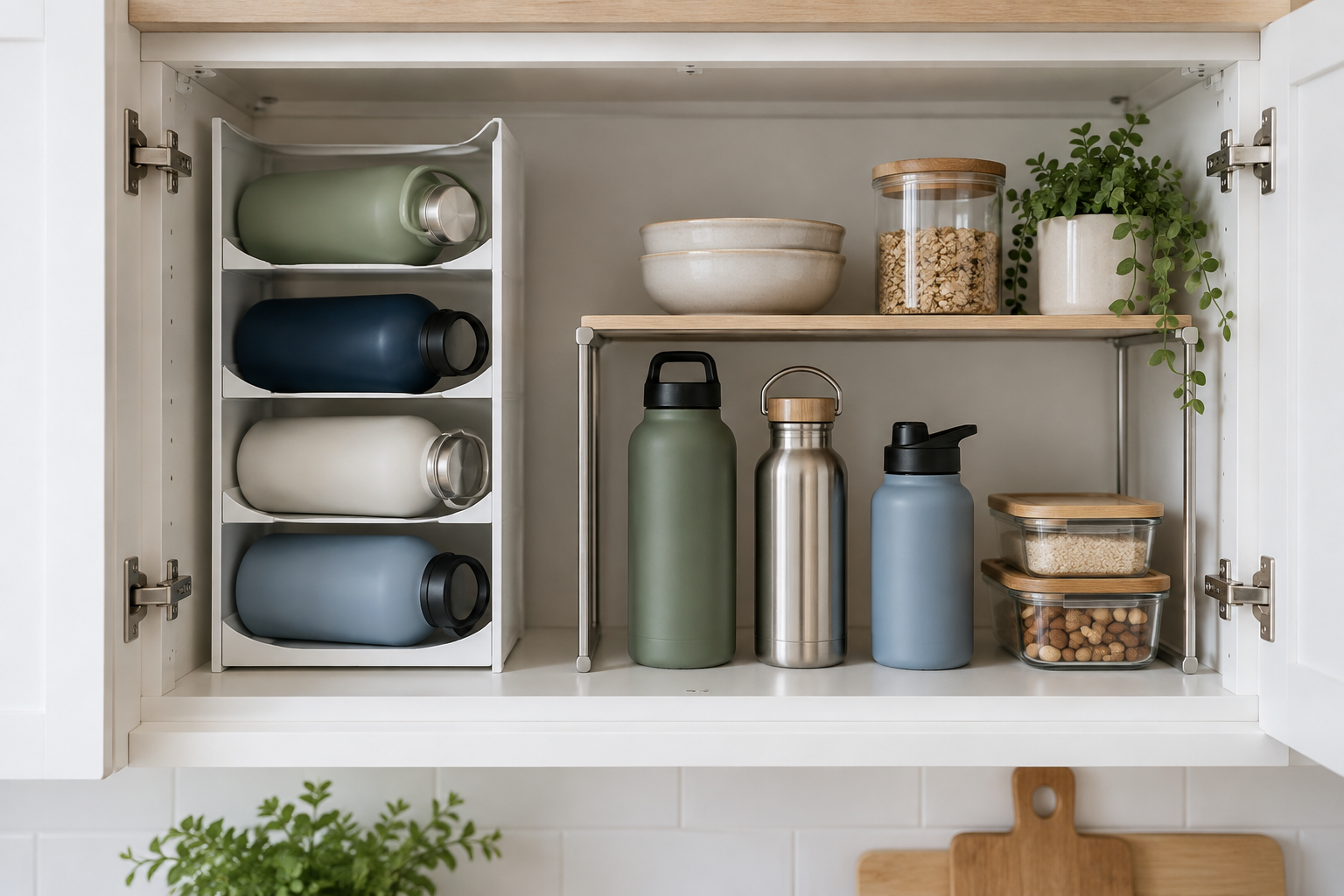
Choose a vertical bottle organizer when separating several clean, empty bottles is the main job. Choose a shelf riser when the cabinet needs a flexible second level for bottles and other items. Neither format fixes a cabinet that has not been measured.
As an Amazon Associate, GoodWeighFinds earns from qualifying purchases.
The quick comparison
| Decision | Vertical bottle organizer | Shelf riser |
|---|---|---|
| Main job | Keeps individual bottles in separate horizontal or angled slots | Creates a second level for mixed cabinet items |
| Best fit | Several frequently used bottles that tip or hide | Unused vertical space above shorter bottles or containers |
| Key measurement | Each slot plus the rack's full loaded footprint | Usable space below, above, and around the riser |
| Access pattern | Pull one bottle from its slot | Reach below the platform or lift items from above |
| Flexibility | Lower when bottle sizes change | Higher for mixed objects that fit the two levels |
| Likely skip reason | Only one or two bottles need storage | The second level makes both rows harder to reach |
Choose the organizer for a bottle-specific problem
A divided organizer is the more direct choice when several bottles roll, topple, or become buried behind one another. Measure the widest bottle body, lid, handle, and bumper, then compare those numbers with the individual slot. Also measure the complete rack: advertised bottle count does not prove that your bottle mix or cabinet opening will fit.
Check the removal path. A bottle can fit inside a slot yet hit the door frame or shelf above when pulled out. A dedicated rack also uses space for dividers, so count how many usable slots remain after the largest bottle is included.
Choose the riser for flexible vertical space
A riser makes more sense when the cabinet has unused height and stores more than bottles. Its platform can hold short containers or bowls while bottles stand below, but only if both levels remain reachable. Measure the narrowest cabinet opening, riser exterior, clear space between its legs, platform thickness, and usable height above it.
Do not translate a seller's load claim into a guarantee for your cabinet or setup. Follow the maker's assembly and loading instructions, use the riser only on a suitable level shelf, and stop using a unit that bends, shifts, or has damaged parts.
Run one cardboard test before buying
Start with clean, fully dry bottles and remove any that are no longer used. Use a sturdy empty box only as a temporary layout mock-up—do not load or rely on it as a shelf. First group the bottles on their sides in separate lanes to simulate a divided rack. Then mark out a second level at the proposed riser height and test the hand clearance for the area below and the space above.
- Count retrieval moves: which setup lets you reach a frequent bottle without moving other items?
- Check the door path: include hinges, frames, shelf lips, and handles in the usable opening.
- Test the full mix: broad insulated bottles, narrow bottles, handles, and lids can change the result.
- Notice wasted space: compare empty slots and blocked corners, not just the product footprint.
- Keep a no-buy result: if one cleared shelf or an existing open bin works, skip both products.
Cleaning, cost, and upkeep
A divided rack has more edges and joints around individual slots; a riser has a larger platform and space underneath to wipe. Read the care directions instead of assuming either item is dishwasher-safe. Include shipping, connectors or add-on tiers, and return shipping in the cost comparison.
Recheck the layout when the bottle collection changes. A specialized organizer loses value when new bottles do not fit its slots, while a riser loses value when tall items eliminate the usable second level.
Listing red flags
- Missing exterior dimensions, slot measurements, under-riser clearance, or assembly directions.
- “Universal,” “fits every bottle,” “tip-proof,” or “perfectly stable” without defined sizes and conditions.
- Capacity photos that do not show handles, broad lids, support points, or the full loaded footprint.
- Stacked configurations without connector details or current maker guidance.
- Claims that either organizer improves hydration, eating habits, health, or weight loss.
- No clear seller, included quantity, care instructions, or return terms.
When to skip both
Skip both when one or two bottles already stand securely, the cabinet opening is too tight for easy removal, or either product would displace higher-priority cookware. Rearranging a shelf, reducing unused bottles, or reusing an open bin may solve the access problem with less cost and cleaning.
For a bottle-only decision, use the vertical organizer buy-or-skip test. If the real problem is unused cabinet height around meal-prep containers, start with the shelf-riser decision guide.
Bottom line
Pick the vertical organizer for repeat bottle-specific access problems and measured slot compatibility. Pick the shelf riser when a tested second level improves access for a changing mix of items. If neither test produces a clear improvement, keep the simpler cabinet layout. For more measure-first decisions, visit the routine-support tools guide.