Buy, delay, reuse, or skip
Is a Vertical Water Bottle Organizer Worth It for a Small Cabinet?
A dedicated organizer is worth considering when several clean, empty bottles repeatedly topple or hide, the slots fit the actual bottle mix, and the loaded rack fits through the cabinet opening. If rearranging one shelf or reusing a bin solves the problem, skip the specialized organizer.
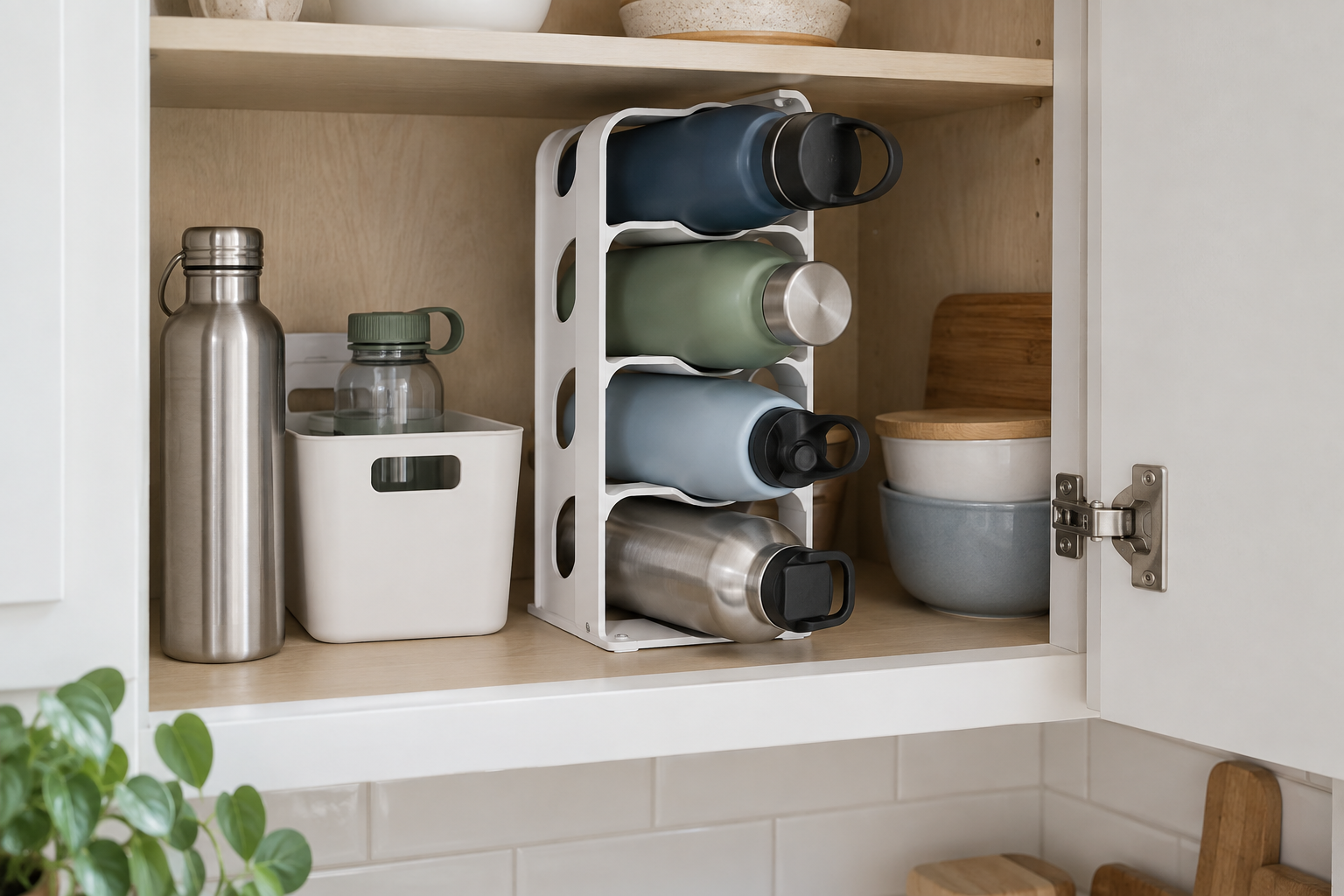
The quick decision
- Buy: at least three frequently used empty bottles create a repeat access problem, a measured organizer fits them, and the loaded unit fits the cabinet.
- Delay: the bottle collection is changing, dimensions are missing, or you have not tested a simpler arrangement for a week.
- Choose an alternative: reuse an open bin, adjust a shelf, or store a small number of bottles upright without dividers.
- Skip: the organizer would hold only one or two bottles, waste shelf volume, block nearby items, or require awkward unloading.
- Escalate the setup: if the cabinet shelf, mounting surface, or organizer appears damaged or unstable, stop loading it and follow the cabinet and product makers' instructions.
Run a seven-day no-buy test
Start with clean, fully dry bottles. Remove bottles that are no longer used, match loose lids to their bottles, and place the remaining collection in one existing bin or a cleared shelf zone. For a week, note which bottles tip, disappear behind others, or require moving several items to reach.
If the test solves the access problem, a new organizer adds cost and another object to clean. If the same bottles still topple or get buried, count the recurring problem bottles and measure them before shopping. Do not use a storage organizer as a drying rack unless its maker explicitly describes that use.
Measure the bottles and the cabinet
- Bottle diameter: measure the widest point, including handles, bumpers, or broad lids that must pass through a slot.
- Bottle length: measure the longest bottle and include any lid loop that projects beyond the body.
- Cabinet opening: measure the narrowest usable width and height past hinges, door frames, and shelf lips.
- Loaded footprint: compare the full organizer width, depth, and height with the shelf—not just one slot.
- Removal path: confirm that each bottle can slide out without hitting the door, shelf above, or neighboring containers.
A listed “four-bottle” capacity does not establish fit. Four narrow bottles may fit where insulated bottles with handles do not. Use measured slot dimensions and the maker's stated orientation rather than assuming a universal bottle size.
Cost, setup, and maintenance tradeoffs
Include the organizer price, shipping, any required clips or stacking parts, and return shipping. A modular rack can cost more if each tier is sold separately. A cheaper one-piece rack may be poor value if one oversized bottle makes a slot unusable.
Check whether the rack arrives assembled, whether stacked sections must connect in a particular direction, and whether tools are required. Read the care instructions before purchase. Narrow dividers, joints, and feet can add cleaning steps, while an open bin may be faster to empty and wipe.
Also account for the shelf space the frame consumes. Dedicated slots can make bottles easier to reach, but dividers may use space that a mixed collection needs. The most compact-looking option is not necessarily the best use of the cabinet.
Red flags on a listing
- No complete exterior dimensions, individual slot measurements, assembly instructions, or clear photo of the support points.
- “Fits all bottles,” “universal,” “tip-proof,” or “perfectly stable” without defined dimensions and conditions.
- Capacity claims that do not show whether handles, broad lids, or mixed bottle shapes were included.
- Stacked product photos without connector details, maximum configuration guidance, or the maker's loading instructions.
- Claims that organizing bottles improves hydration, eating habits, health, or weight loss.
- A marketplace listing that hides the seller, return terms, material description, or quantity included.
Who should skip it
Skip a dedicated rack when the bottles are rarely used, only one or two need storage, or a plain bin already keeps the collection accessible. It is also a poor fit when the cabinet opening is narrower than the shelf, removing the rack requires lifting a heavy group of bottles, or the organizer blocks cookware and other higher-priority items.
Delay the purchase if the household is replacing bottles soon or cannot verify the organizer's dimensions and return path. If reaching the cabinet or lifting a loaded organizer is difficult, choose a reachable shelf and lighter arrangement rather than relying on a product claim about convenience.
Alternatives that may fit better
An existing open bin keeps a mixed bottle collection together and can be pulled forward, although bottles may still touch or tip. A shelf riser can use vertical cabinet space for short items, but it does not separate bottles and needs its own measured clearance. Upright storage without an organizer can work for a small, similar-size collection.
If you still need to choose the format, compare a vertical bottle organizer with a shelf riser by measured fit, retrieval path, cleaning, and future flexibility. If dedicated slots win, use the vertical bottle organizer guide to compare divided racks and open bins by exact fit, access, care, and skip criteria. If bottles are wet after washing, compare bottle drying racks instead of placing damp parts into closed storage.
Bottom line
A vertical water bottle organizer is worth buying only when a one-week test confirms a recurring access problem and measured slots solve it without wasting cabinet space. Otherwise, rearrange the shelf or reuse a bin. For more practical tools that support routines without body-result promises, visit the routine-support tools guide.