Everyday walking carry comparison
Walking Belt vs Crossbody Phone Holder for Everyday Walks
A walking belt holds a small load close around the waist. A crossbody phone holder keeps the phone higher and may be easier to reach. Neither format improves a walking routine by itself: the better choice is the one that fits the phone, keys, clothing, and route without adding distracting movement or unnecessary bulk.
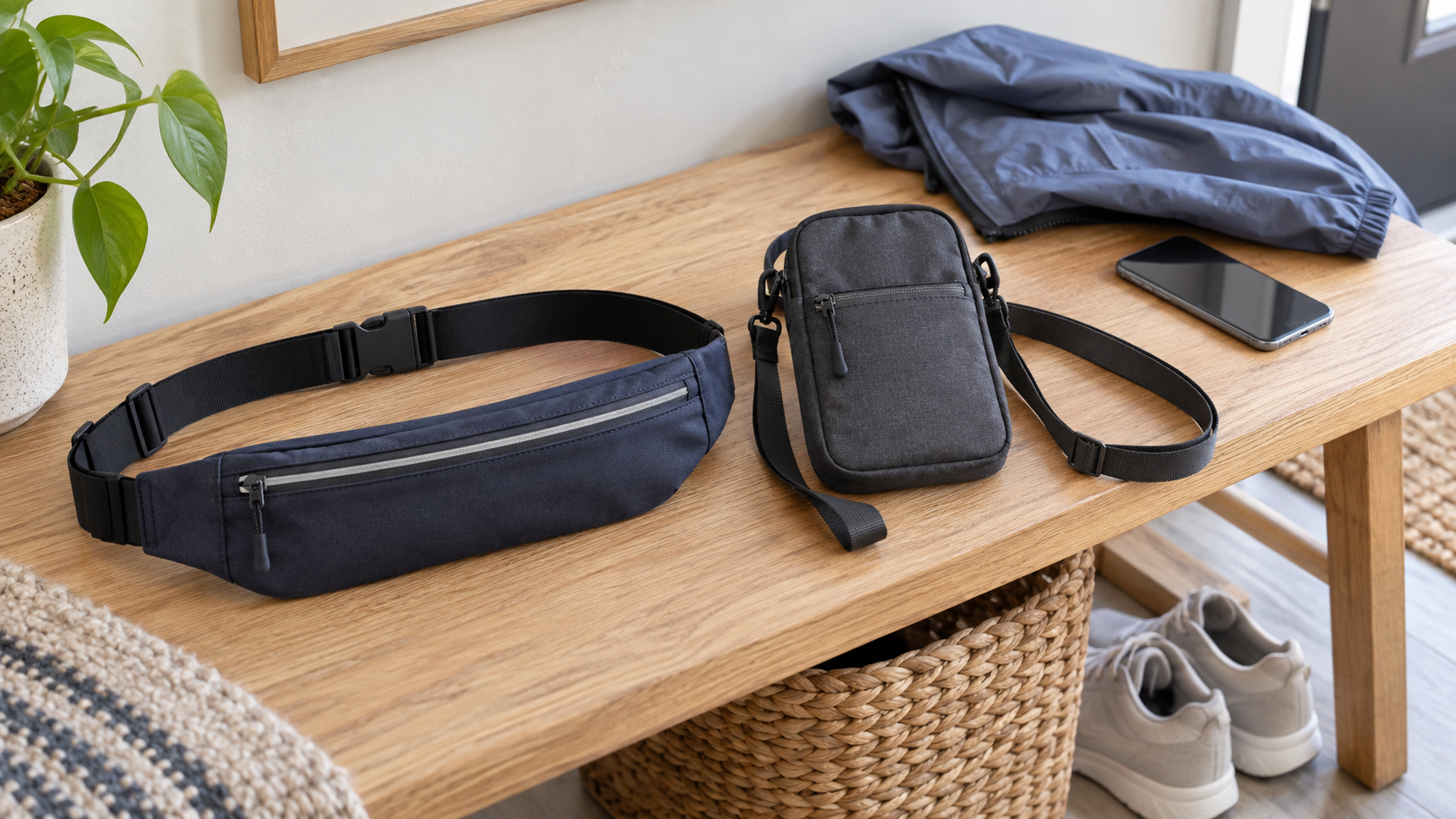
As an Amazon Associate, GoodWeighFinds earns from qualifying purchases.
Quick decision
| Choose a walking belt when… | Choose a crossbody holder when… |
|---|---|
| You want a phone, keys, and perhaps one small extra held close around the waist. | Your main item is a phone and you prefer access from the chest or hip. |
| The measured belt range works over your usual clothing without pinching or slipping. | The strap adjusts to the carry height you want over your usual layers. |
| You prefer weight centered at the waist and can reach the closures comfortably. | You dislike waist pressure and do not mind a one-shoulder strap. |
| The pocket layout separates keys from the phone screen and case. | The pouch opening and any secondary pocket fit the complete load. |
Start with the exact carry load
Lay out what goes on an ordinary walk rather than packing for every possible errand. Measure the phone with its case, then include a key ring, cards, medication or other essentials only if they recur. Compare those measurements with usable pocket dimensions and openings—not just the listing's overall exterior size.
A belt can look roomy when empty but become rounded or press awkwardly once a phone and keys share the pocket. A crossbody holder may fit the phone while leaving no secure space for keys. Look for separate sleeves or pockets when hard objects could rub the screen, and do not treat an unmeasured “universal” label as compatibility proof.
Compare fit, movement, and access
For a belt, check the complete adjustable range, webbing width, buckle position, stretch, and whether the listing explains how sizing was measured. Try the intended position over the same waistband or outer layer used on walks. A close fit may reduce movement, but “bounce-free” remains a model-specific marketing claim rather than a guarantee.
For a crossbody holder, check strap length, width, attachment points, and the pouch's loaded orientation. A shorter setting may keep it close; a longer one may improve reach but allow more swing. Hardware and strap edges should not sit where they repeatedly rub. Neither style is universally more comfortable, because fit depends on body shape, clothing, load, pace, and sensitivity to pressure.
Practice opening and closing the carrier while stopped in a safe place. A phone that is quick to reach but easy to drop is not a useful trade. If limited reach, balance, or dexterity affects access, choose around that need rather than a generic format label.
Security and route awareness
Compare zipper, snap, hook-and-loop, or open-top closures by what they actually secure. Inspect whether the phone can work toward an opening as the carrier moves and whether a key clip is included or merely shown in styled photos. Keep the closure shut as designed and avoid overfilling it.
Close-to-body storage does not make a route or device theft-proof. On crowded routes, consider where the opening sits and whether you can keep it in view. Around traffic, do not let checking or retrieving the phone replace attention to surroundings. For low-light walks, a small reflective strip is a product detail, not a visibility guarantee; use the broader reflective-gear guide to assess placement and route needs.
Weather, cleaning, and clothing
- Weather wording: “Water-resistant” and “waterproof” claims vary. Verify which fabric, zipper, seams, and exposure the current claim covers; neither label guarantees protection in every rain event.
- Sweat and cleaning: Check the maker's washing or spot-cleaning directions, whether straps and hardware can be submerged, and how enclosed pockets dry.
- Seasonal layers: Measure strap or belt fit over the jacket, sweater, or waistband actually used, not only over light indoor clothing.
- Phone heat: Avoid assuming a pouch controls device temperature. Follow the phone maker's operating and storage guidance.
- Returns: Confirm the seller and current return terms before buying, because loaded fit and reach can be difficult to judge from listing photos.
Claims and evidence boundaries
Dimensions, listed materials, included parts, and care directions should come from the current maker or seller page and remain specific to that model. Comfort and durability depend on fit, construction, load, route, use, and care. Customer comments may flag questions to investigate, but they do not prove that a carrier will fit another person or last for a set period.
Neither carrier causes weight loss, improves fitness on its own, guarantees device security, or makes walking safe. The practical claim is narrower: a well-fitting holder may give a few everyday items a consistent place.
How this differs from nearby guides
This page compares waist carry with shoulder carry. If you already know you do not want a waist belt, the phone-holder guide compares crossbody pouches with armbands, clips, and tethers. If you need water or a folded layer too, compare a water bottle sling with a walking backpack. The routine-support tools pillar keeps the decision focused on a real task rather than body-result promises.
When to skip both
- A secure pocket or carrier you already own fits the normal load.
- You have not measured the phone with its case, the keys, the pocket opening, or the intended strap range.
- The listing omits usable dimensions, closure details, care directions, seller information, or understandable return terms.
- You need specialized medical, mobility, emergency, or technical gear storage that an ordinary consumer phone carrier is not designed to provide.
- Waist pressure, one-shoulder carry, cords, or dangling straps conflict with your comfort, reach, clothing, route, or equipment.
Bottom line
Choose a walking belt when a measured small load works best centered at the waist. Choose a crossbody phone holder when phone access and avoiding waist pressure matter more, and the adjusted pouch stays manageable on the route. Verify the complete load and listing details, then skip a new carrier when a secure pocket already solves the problem.