Small-entryway shoe-care guide
Best Boot Scrapers for Muddy Walking Shoes at Small Entryways
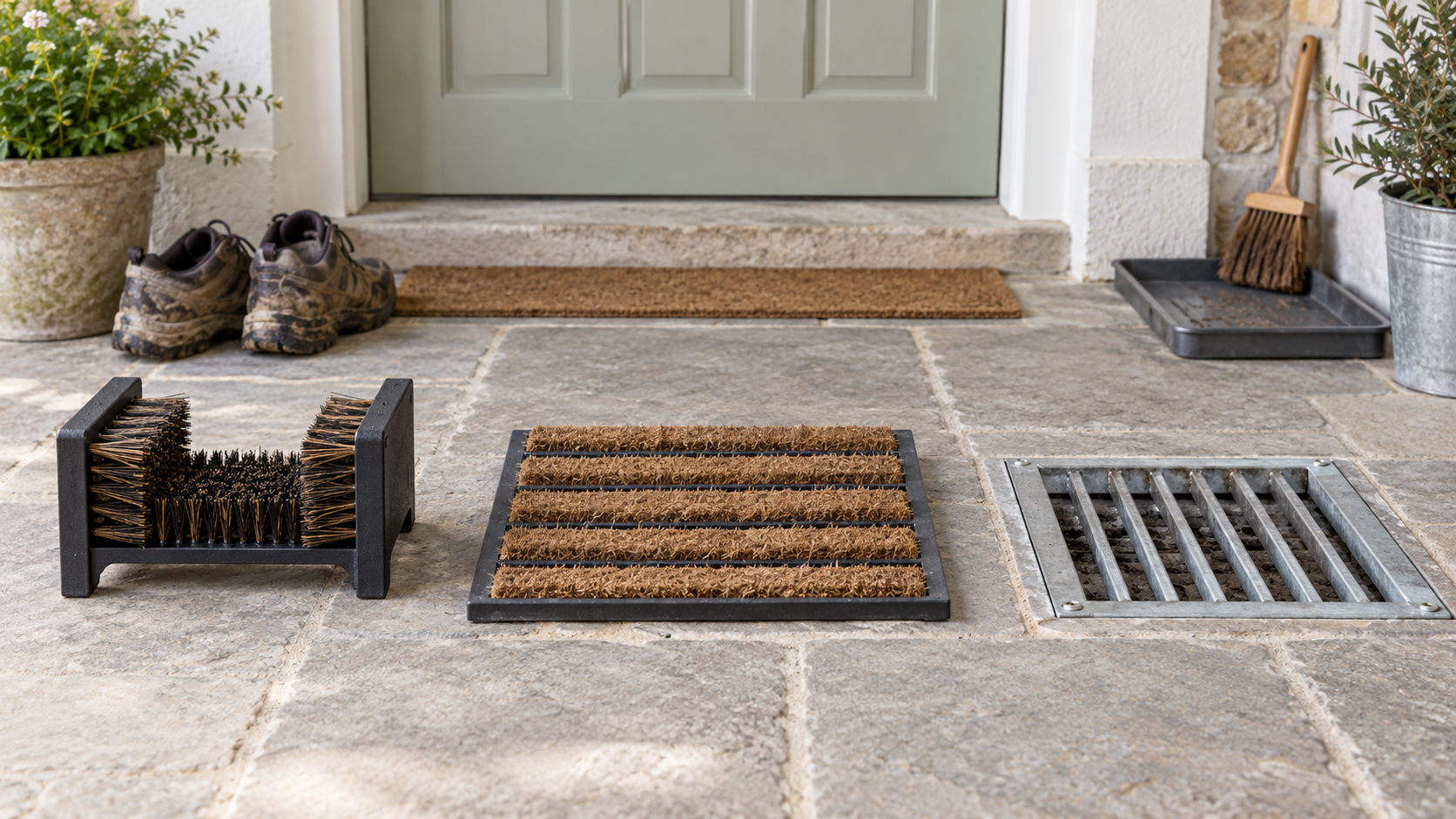
The useful boot scraper is the one that fits a permitted, stable cleanup spot and reaches the tread on the shoes you actually wear. In a small entryway, compare the complete use area and debris routine before choosing bristles, a low-profile mat, or a grate.
As an Amazon Associate, GoodWeighFinds earns from qualifying purchases.
Start after the buy-or-skip decision
This guide assumes a fixed or floor-level scraper already makes sense for a recurring mud problem. If that is not settled, first use the boot scraper buy-or-skip guide. If removing the shoe and cleaning it by hand is more practical, compare a shoe brush with a boot scraper instead.
A scraper is a cleanup tool, not a safety device. It does not restore worn tread, guarantee grip, prevent falls, or make footwear suitable for a route. Follow the footwear maker's care instructions and reject any scraper that would obstruct the entrance or require awkward balance.
Choose a format by the cleanup job
| Format | Compare it when | Main tradeoff |
|---|---|---|
| Freestanding bristle frame | The usual sole has deep tread and side brushes may help with edge debris. | Its raised frame needs a larger clear use area than its listed footprint suggests. |
| Low-profile scraper mat | A flatter movable surface fits and light surface debris is the main problem. | Check edge height, backing, stated surface use, and how debris is emptied. |
| Grate-style scraper | Loose material can fall through into an accessible tray or permitted collection area. | Openings must suit the usual shoe; cleaning below can add work. |
| Mounted scraper | A permanent installation is allowed and the surface meets the maker's instructions. | Installation, exposure, clearance, and removal may outweigh compact storage. |
Measure the full use area, not just the product
Record the listed width, depth, and height, then mark that footprint with painter's tape or cardboard. Add room for the standing foot, moving shoe, open door, and any brush or pan used to collect debris. Keep the normal path clear rather than treating the scraper itself as the only footprint.
Check threshold height, door swing, stairs, handrails, drainage, shared access, lease or building rules, and whether the spot is covered. “Indoor/outdoor” and “weather-resistant” are listing claims, not permission to ignore placement instructions or property rules.
Match the contact surface to the usual shoe
- Tread access: Compare bristle spacing, ridges, or grate openings with the deepest and narrowest parts of the usual sole.
- Upper clearance: Make sure brushes or frame edges do not contact delicate uppers, trim, or fasteners contrary to shoe-care directions.
- Working direction: Check whether the product expects a forward pull, side-to-side motion, or step-through movement and whether that motion fits.
- Shoe range: A format that fits a sturdy walking shoe may not suit sandals, narrow shoes, soft uppers, heels, or mobility footwear.
- Replacement parts: Verify that the exact maker lists compatible brushes, inserts, trays, or fasteners rather than assuming generic parts fit.
Check the base or installation
For a freestanding model, inspect the listed weight, base shape, feet, and surface guidance. Do not turn “heavy duty” or “non-slip” copy into a stability guarantee. For a mounted model, verify required fasteners, substrate, clearances, tools, and permission; photos do not establish compatibility with brick, wood, concrete, siding, or a rental property.
A mat or grate also needs a level, supported placement that follows the maker's instructions. Avoid improvised anchoring, loose boards, uneven pavers, or any position where the tool could catch a foot or block an exit.
Plan debris collection and cleaning
Ask where loose mud goes. Bristle frames may hold dirt at the base, mats may need lifting and shaking in an appropriate place, and grates may need an accessible tray or surface beneath them. Confirm that the item and removable parts can be cleaned and dried according to current instructions.
If wet-shoe drips rather than packed tread mud are the recurring issue, a compact boot tray addresses floor containment more directly. A scraper and tray can work together only when the loaded setup fits and both remain easy to clean.
Claims to verify rather than assume
- “All-weather” or “rust-resistant”: Check material, coating, exposure limits, maintenance, and warranty language.
- “Non-slip”: Identify the stated surface and setup; do not treat the phrase as fall-prevention evidence.
- “Fits all footwear”: Compare actual openings and brush clearance with the shoes and their care instructions.
- “Cleans in seconds”: Treat speed as marketing unless a useful method and conditions are documented.
- “Heavy duty”: Look for dimensions, materials, fasteners, placement, and stated use rather than relying on the label.
Who should skip a boot scraper
Skip every fixed format when the entrance is narrow, uneven, shared, close to stairs, or needed for mobility equipment; when the tool would sit beyond its stated placement limits; or when the usual shoes rule out aggressive brushing or scraping. A handheld brush used with the shoe removed may offer more control and easier storage.
Do not rely on a scraper when using it requires uncertain one-foot balance, painful movement, or support the entry does not provide. Those are individual mobility questions, not product-selection problems. Also skip the purchase when a cardboard placement test shows that the door, route, cleanup tools, and user cannot all fit comfortably.
A practical selection checklist
- The format solves recurring packed mud rather than an occasional cleanup.
- The full use area leaves the door, stairs, handrail, and normal route clear.
- Bristles, ridges, or openings fit the usual shoe tread and care instructions.
- The base or installation matches the exact surface and property rules.
- Stated placement and weather limits fit the intended location.
- Debris can be collected without scattering it through the entry.
- All parts can be cleaned, dried, and stored as directed.
- The current seller and return terms are clear.
Bottom line
For a small entryway, “best” means a measured format that reaches the usual tread without blocking the route or creating a harder cleanup job. Compare bristle frames, low-profile mats, and grates by complete use area, shoe contact, base or mounting, placement limits, debris handling, and care. If no format passes the cardboard test, use a handheld brush and tray. For the broader product path, return to the routine-support tools guide.