Small-kitchen storage buying guide
Best Cabinet-Door Organizers for Food-Storage Lids
A door-mounted organizer can move lightweight lids off a shelf, but only when the loaded rack clears the cabinet frame, hinges, shelves, and everything stored inside. The best format is the one that fits the measured door and documented mounting method—not the one that claims the largest capacity.
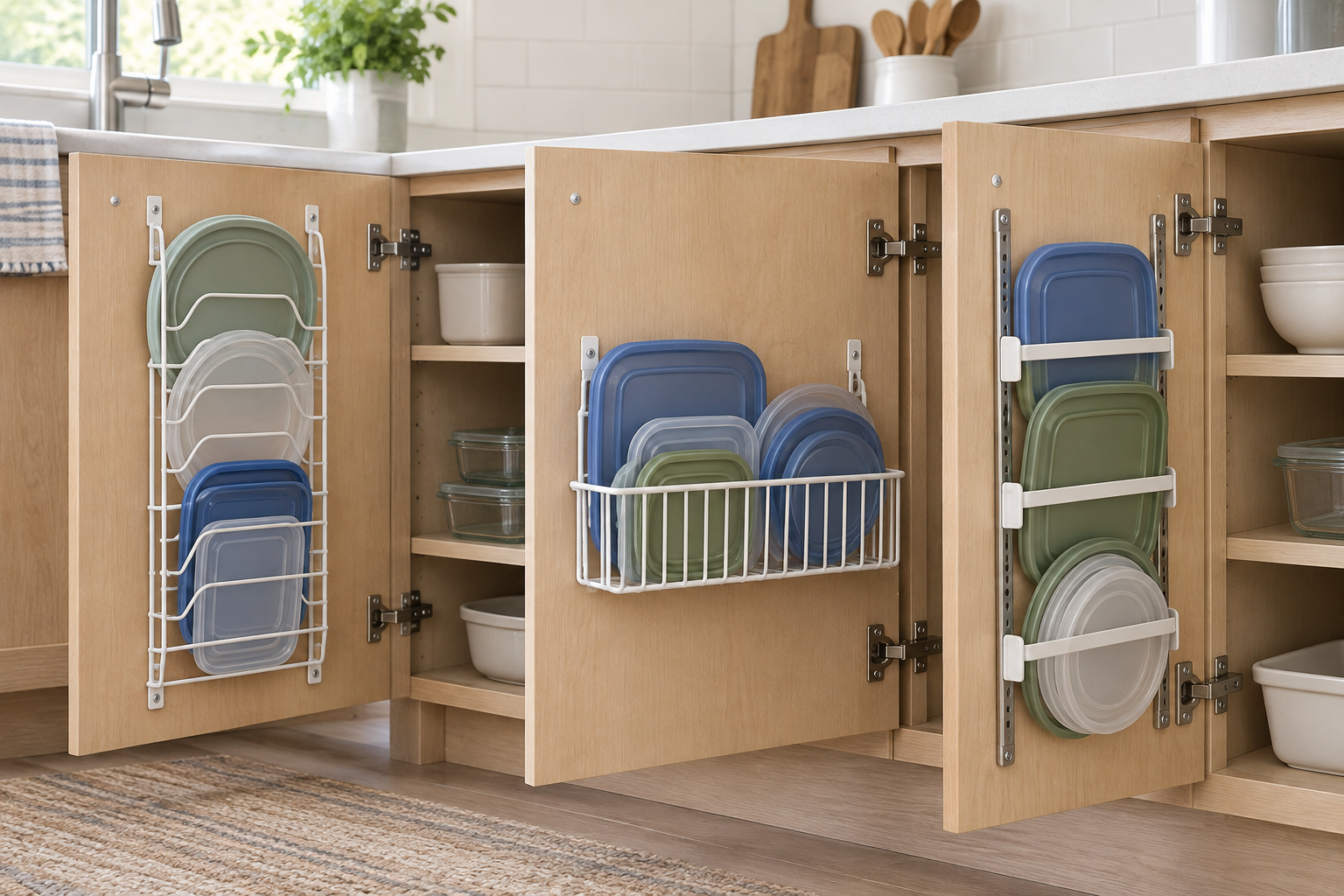
Start with the door-closing test
Measure the empty door first, then model the organizer when loaded. Record the flat usable width and height between hinges, bumpers, latches, and raised door details. Next, close the door slowly while holding a cardboard mock-up at the proposed depth. Check the cabinet frame, shelf edges, bowls, containers, and handles at every point in the swing.
A listing’s organizer depth is only part of the number. Add the thickest lid, any outward lean, screw heads or hooks, and the clearance needed to lift a lid out. If a shelf sits close to the door, measure with the actual shelf contents in place. “Fits most cabinets” is not a substitute for those dimensions.
Which cabinet-door organizer format fits the job?
| Format | Best reason to compare it | Main constraint to verify |
|---|---|---|
| Slim fixed wire rack | A small, stable lid collection fits one known width | Slot spacing, rail height, loaded depth, and screw locations |
| Shallow open basket | Mixed lid shapes are easier to drop in than sort into slots | Small lids tipping, pile depth, retrieval space, and basket projection |
| Adjustable rail or divider holder | Several lid widths need separate lanes | Adjustment range, smallest supported lid, hardware, and parts that can loosen |
| Over-door hook rack | Drilling is not allowed and the door top can accept hooks | Hook thickness, door closure, frame contact, noise, and finish protection |
None is a universal winner. A fixed rack can be simple but unforgiving of unusual lids. A basket accepts more shapes but can become a stack you have to sort. Adjustable rails can improve separation while adding more measurements and parts. An over-door format avoids holes only when the cabinet geometry explicitly accommodates its hooks.
Selection criteria that matter
- Loaded depth: Add the rack, thickest lid, tilt, mounting hardware, and retrieval clearance.
- Usable width and height: Measure between hinges and other hardware, not across the entire door panel.
- Lid retention: Compare rail height and spacing with the smallest, largest, round, and rectangular lids you actually keep.
- Mounting method: Follow the maker’s stated surface, fastener, preparation, cure-time, and load instructions. Do not assume an adhesive is removable or suitable for every finish.
- Door material: Thin panels, raised profiles, glass inserts, damaged surfaces, and rental restrictions can rule out mounting.
- Access: Make sure one lid can leave without unloading the whole rack or forcing the door beyond a comfortable opening.
- Cleaning: Check whether the organizer can be removed or wiped around and whether crumbs and moisture can collect in the bottom.
- Current terms: Confirm included hardware, warranty wording, seller, returns, and any product-specific load statement on the current listing.
A simple comparison framework
- Match and reduce the collection. Pair every lid with a container and relocate or recycle unmatched pieces where local rules allow.
- Measure the largest routine set. Use the lids normally in rotation rather than an aspirational capacity number.
- Make a cardboard mock-up. Reproduce the organizer’s width, height, and loaded projection, then tape it temporarily in place without treating that tape as installation.
- Test the full swing. Open and close the door slowly, including adjacent doors and drawers, and retrieve representative lids.
- Read mounting instructions before ordering. Confirm the surface, tools, hole locations, adhesive preparation, stated load, and removal language.
- Compare the least complicated format that passes. Extra slots and adjustability have little value if they reduce access or add failure points.
Who should skip a cabinet-door organizer?
Skip this category when the door is too thin, damaged, already loaded, fitted with a glass or raised center panel, or not permitted to be drilled or altered. Skip it when the loaded organizer conflicts with hinges, shelves, containers, latches, an adjacent door, or a child-safety device. An adhesive listing that does not name your surface or explain removal is not evidence of damage-free use.
Also skip it when the collection changes constantly, includes heavy glass lids or cookware lids, or cannot be reduced to a modest set of lightweight food-container lids. A shallow bin on a shelf, lids nested with matched containers, or a drawer organizer may be simpler and easier to inspect.
How this guide differs from the broader lid-organizer pages
This page assumes cabinet-door storage has already won the placement decision. If that decision is unresolved, compare a drawer organizer with a cabinet-door organizer first. If you are still deciding whether any dedicated organizer is worthwhile, use the lid-organizer buy-or-skip test. The broader container-lid organizer guide compares racks, bins, drawers, and door-mounted formats.
For the larger principle—buy ordinary tools only when they remove a repeated routine bottleneck—see the routine-support tools pillar. A lid rack can change storage access; it does not improve nutrition or produce weight-loss results.
Bottom line
Choose a cabinet-door lid organizer only after the exact loaded footprint passes a real closing and retrieval test. Compare fixed racks, open baskets, adjustable rails, and over-door hooks by measured compatibility, documented mounting, access, cleaning, removal, and current seller terms. If the door cannot support the setup without guesswork, use a shelf or drawer solution instead.