Measured-fit packed-lunch accessory guide
Best Hard Utensil Cases for Packed Work Lunches
A rigid utensil case can keep ordinary reusable cutlery contained in a crowded lunch bag, but only when its usable interior fits the actual pieces and its fixed exterior fits the loaded bag. Compare measurements, closure, cleaning access, and drying—not “best” badges or accessory count.
As an Amazon Associate, GoodWeighFinds earns from qualifying purchases.
Who this guide is for
This guide is for adults who already know rigid storage fits their packing routine and now need to compare case formats for ordinary reusable table cutlery. It does not rank utensil sets, sharp knives, disposable cutlery, or soft pouches.
If the format decision is not settled, start with the utensil pouch versus hard-case comparison. If you are unsure whether any rigid case earns its fixed space, use the hard-case buy-or-skip guide. The broader insulated lunch-bag pillar covers the full carry setup.
Best-fit formats, not named winners
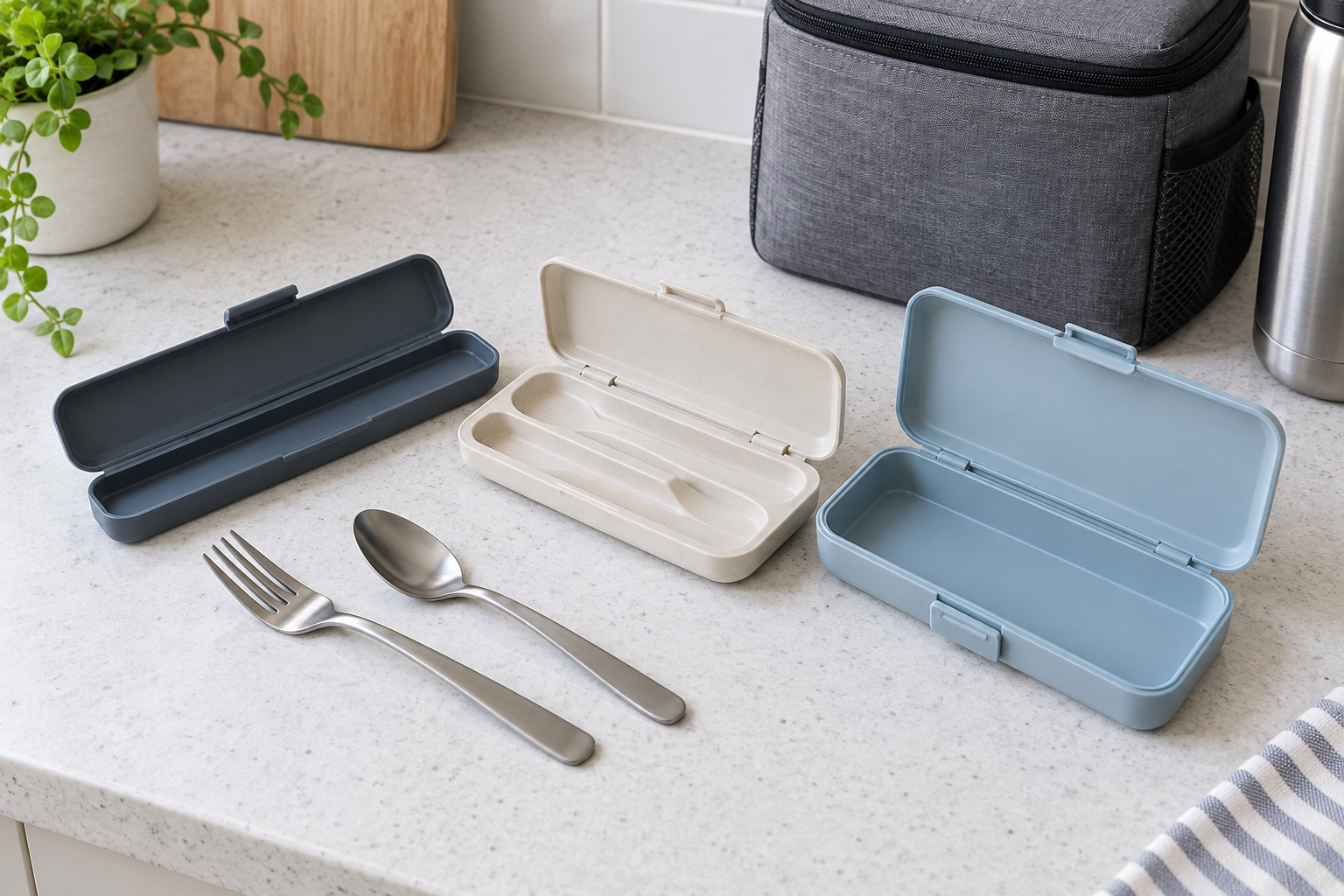
| Case format | Useful when | Main tradeoff to check |
|---|---|---|
| Slim open-interior case | You carry a simple fork-and-spoon pair and need the narrowest rigid footprint | Loose pieces may shift or rattle, and exterior length still has to clear the bag |
| Fitted or divided case | You want each intended piece held in a defined recess | Molded sections can reject wider handles and add corners that need cleaning and drying |
| Wider multipiece case | You regularly carry additional ordinary table utensils | Extra width and depth can press container latches or consume cold-pack space |
| Small rigid container already owned | It fits the cutlery, closes reliably, and is easy to inspect and care for | It may use more space, but it avoids a specialized purchase |
Measure interior fit and exterior bulk separately
Measure the longest fork, spoon, or blunt table knife from end to end, then measure the widest stacked bundle. A listing's exterior length is not proof of usable interior length: hinge barrels, end curves, molded stops, dividers, and latch hardware can reduce the space inside. Look for explicit interior measurements or seller diagrams rather than subtracting an assumed wall thickness.
Next, make a paper or cardboard rectangle matching the case's closed exterior dimensions and place it in the lunch bag with the normal containers, bottle, and cold pack. Confirm that it does not press a lid latch, bow the bag zipper, or require turning utensils diagonally. A slim-looking case can still be too long for a compact bag.
Selection criteria that matter
- Usable interior dimensions: Require clearance for the exact utensils without bending the hinge, forcing the lid, or loading a utensil tip against an end wall.
- Closure: Check how a snap, latch, sliding lid, or friction fit engages when the case is loaded. “Secure” and “leakproof” are claims, not category facts.
- Hinge and latch access: Look for corners and moving parts that can be reached during cleaning and opened enough to dry.
- Interior layout: Fitted recesses can reduce movement but only if handle widths and utensil heads match. An open interior is more flexible but may allow rattling.
- Material disclosure: Prefer specific material identification and care directions over broad “food grade,” “eco-friendly,” or “premium” language.
- Component-specific care: Verify whether dishwasher wording applies to the case, cutlery, removable insert, or only selected components.
- Inside visibility: A light-colored, fully opening interior can make residue, trapped moisture, cracks, and damaged surfaces easier to notice.
- Included-item clarity: Confirm whether pictured utensils come with the case. This guide compares cases for cutlery you already own.
- Loaded-bag fit: Check exterior length, width, depth, and orientation against the real packed bag—not an empty product photo.
- Seller and returns: Verify current terms when measurements, materials, or included pieces remain unclear.
A practical comparison framework
Mark each candidate yes, no, or unclear. Treat an unclear answer as a reason to verify the current listing or choose a better-documented option.
- Are usable interior dimensions stated, and do they clear the exact utensils?
- Does the closed exterior fit the fully loaded lunch bag in a stable orientation?
- Can the closure engage without pressure from utensil handles or heads?
- Can every seam, recess, hinge area, and latch surface be reached for cleaning?
- Can the case remain fully open while all parts dry?
- Are materials and care directions specific to the case itself?
- Is it clear whether staged cutlery is included?
- Would a washable wrap, built-in pocket, or existing container solve the same problem?
Run a no-buy fit test
Place clean, dry utensils in a small rigid container you already own, or make a simple cardboard sleeve matching a candidate's exterior measurements. Pack the normal lunch around it for several trips. This will not reproduce a product's hinge or cleaning steps, but it reveals whether a fixed footprint improves containment or merely crowds the bag.
If the stand-in presses other items, the first fix may be a softer carrier or fewer carried pieces rather than a different hard case. Compare soft utensil pouch formats after deciding that flexibility matters more than structure.
Who should skip a hard utensil case
Skip this purchase if a lunch-bag pocket, washable napkin wrap, existing clean container, or spare set kept at work already solves the problem. Skip cases without usable interior measurements, material details, care instructions, or clear included-item wording.
A rigid case is also a poor fit for sharp kitchen knives, utensils that must be forced inside, or a bag so crowded that the case presses food-container closures. Follow workplace and transit rules for any carried knife; this guide concerns ordinary blunt table cutlery.
Claims and evidence limits
A hard case can contain compatible utensils and provide structure around them. It does not sanitize unwashed cutlery, keep every spill out, prevent all damage, or guarantee an organized lunch bag. “Antimicrobial,” “odor proof,” “stain proof,” “leakproof,” “unbreakable,” and similar language requires product-specific support and is not necessary for judging basic fit.
This category supports a packing routine. It does not change nutrition, appetite, or body weight.
Bottom line
Choose a rigid utensil case only after both the usable interior and closed exterior pass measured-fit tests. Prefer a closure that works without strain, clear material and care information, an interior you can inspect, and a hinge-and-latch design that can be washed and fully dried. Keep the simpler option you already own when it does the same job with less bulk.