Batch-cooking tool guide
How to Choose Prep Bowls With Lids for Batch Cooking
The most useful lidded prep bowls are not necessarily the largest set. They are the few sizes that match ingredients you repeatedly stage, with lids you can identify, clean, dry, and store without creating a second organization problem.
As an Amazon Associate, GoodWeighFinds earns from qualifying purchases.
Choose the workflow before the material
Start by recording two ordinary batch-cooking sessions. Count only ingredients that benefit from separate staging and note which ones need a brief covered pause. If ingredients move straight from the cutting board to the pan, extra bowls may add washing without reducing friction.
If you are still deciding whether a dedicated set earns its space, use the prep-bowl buy-or-skip test first. If the real need is storing or carrying finished food, compare prep bowls with meal-prep containers instead.
Three useful formats to compare
| Format | Potential fit | Verify before buying |
|---|---|---|
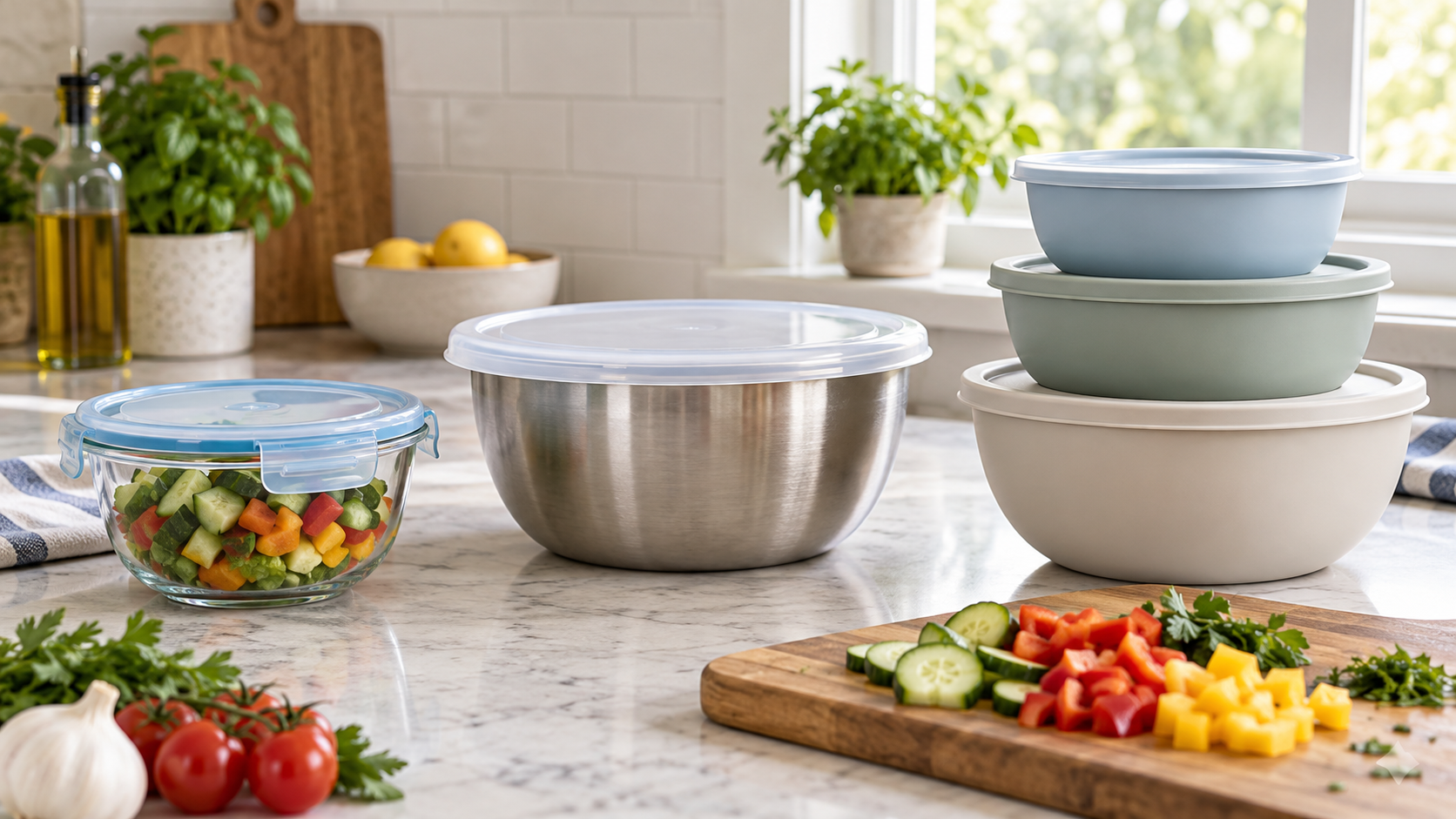
| Glass bowls with locking or press-on lids | When visibility and a rigid bowl matter more than low weight | Individual weight, rim and lid design, nesting, chip inspection, and separate bowl and lid appliance labels |
| Stainless-steel bowls with fitted lids | When a lighter rigid bowl and compact nesting are priorities | Interior size marks, base shape, lid material, nesting with lids removed, care, and any stated appliance limits |
| Plastic nesting bowls with matching lids | When low weight and several graduated sizes fit the prep sequence | Material disclosure, usable capacities, lid identification, staining claims, care, replacement options, and full stored height |
These are format-level tradeoffs, not performance findings. Material alone does not establish durability, lid security, odor resistance, stain resistance, or safe use in an appliance.
Selection criteria that matter
- Useful bowl count: Ignore a piece count that includes every lid. List the bowl sizes you would use in one normal cooking session.
- Outside dimensions: Capacity does not show how much counter or shelf space the bowl occupies. Compare rim diameter, height, and the complete nested stack.
- Lid handling: Check tabs, alignment marks, flex, and the force described by the maker. Similar-looking lids need an obvious matching system.
- Nesting with lids: Product photos may show bowls nested while lids are stored elsewhere. Plan a measured location for both parts.
- Material and use labels: Read the exact instructions for bowl and lid separately. Do not assume dishwasher, microwave, freezer, or oven use.
- Cleaning access: Look for seams, gasket channels, textured rims, and lid features that need separate washing or drying.
- Replacement path: Verify whether compatible lids can currently be identified and purchased; do not treat availability as permanent.
- Seller and returns: Confirm the exact set, included sizes, seller, and current return terms before ordering.
A simple size audit
- Write down the approximate amount of each repeatedly staged ingredient.
- Match those amounts to stated usable bowl capacities, leaving practical handling room.
- Mock up each outside diameter on the counter with paper or existing dishes.
- Measure the complete cabinet location, including shelf height and the place where lids will live.
- Reject sets with several sizes that have no recurring job.
This audit is more useful than choosing by set size or staged photography. A compact three-bowl set can fit better than ten pieces, while existing food-storage containers may make a new set unnecessary.
Claims to treat cautiously
Words such as “airtight,” “leakproof,” “unbreakable,” “stain-proof,” “odor-proof,” and “lifetime” need exact definitions and current product documentation. A fitted lid can keep staged ingredients covered during part of a workflow, but it does not by itself prove transport performance, preservation, or a food-storage duration.
Prep bowls are routine tools. They do not control portions, improve nutrition, make food safe, or cause weight loss. Skip listings that turn an ordinary bowl set into a body-result or health promise.
Who should skip a dedicated set
Skip it when existing bowls or containers already match the ingredients, when most chopped items go directly into the pan, when loose lids are already a storage problem, or when the listing omits individual sizes and care instructions. A plate over an existing bowl may be enough for a brief pause in some workflows.
For finished-food storage, start with the meal-prep container guide. For the broader choose-by-problem approach, use the routine-support tools guide.
If clothing coverage and reachable storage are separate prep frictions, use the aprons-with-pockets guide to compare garment dimensions, straps, pocket placement, laundering, and storage without relying on protection or cooking-outcome claims.
Bottom line
The best lidded prep-bowl set is the smallest set that covers repeated ingredient-staging jobs, fits the working counter and cabinet, and has lids and care instructions you can manage. Measure the workflow first, verify every model-specific claim, and reuse what you own when it already works.