Car-free grocery carry comparison
Insulated Grocery Bag vs Cooler Backpack for Car-Free Shopping
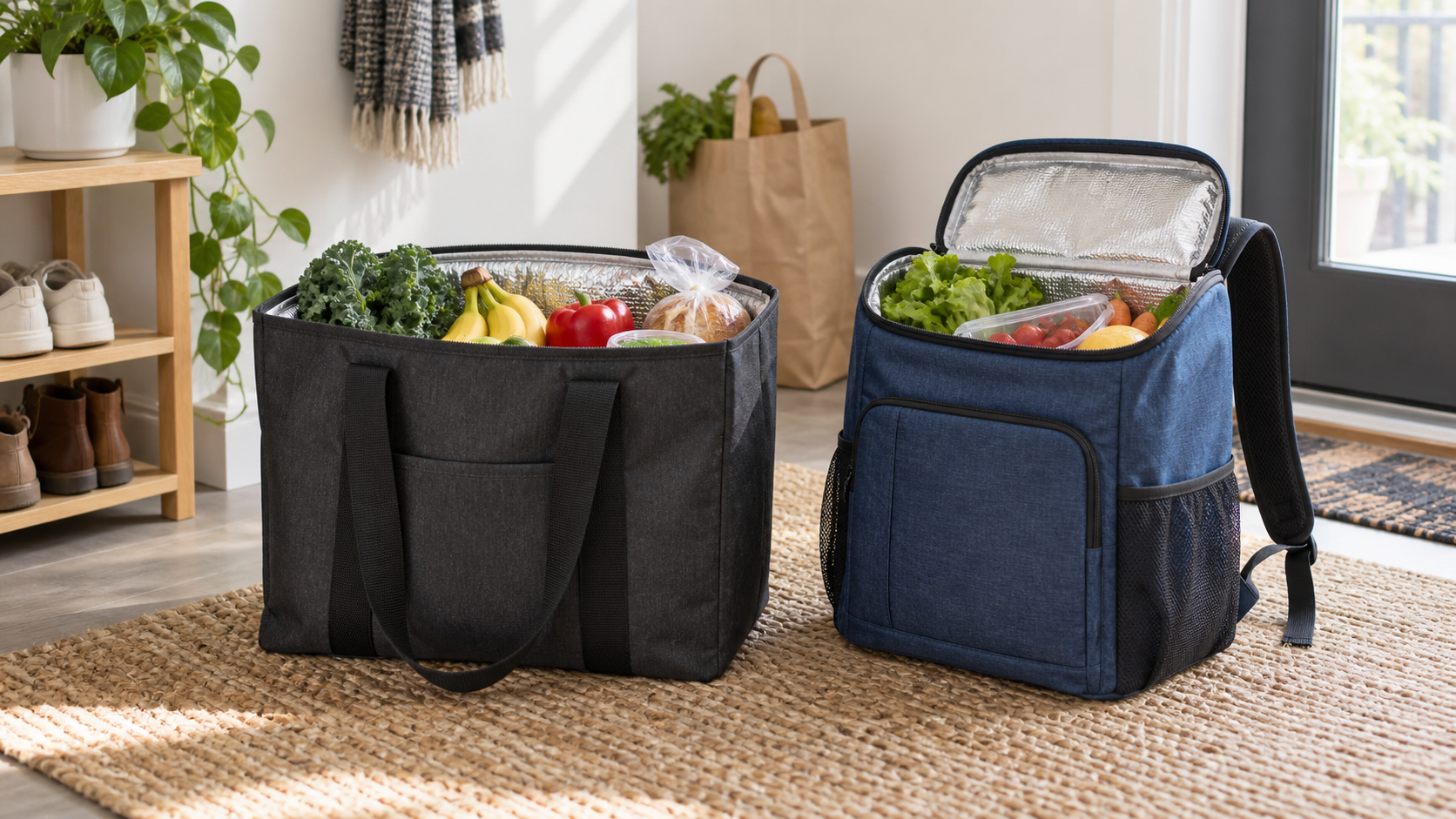
An insulated grocery tote keeps its wide opening and carries by hand or shoulder. A cooler backpack moves the load onto two shoulder straps and leaves both hands available. For a walk, bus, or train trip, the better format depends on the whole route—not on a staged capacity photo or an unsupported temperature claim.
As an Amazon Associate, GoodWeighFinds earns from qualifying purchases.
Quick decision
| Choose an insulated grocery tote when… | Choose a cooler backpack when… |
|---|---|
| Your usual load is easy to carry by hand and a wide opening makes packing simpler. | You need both hands free for transit, doors, railings, or another light bag. |
| The bag needs to sit flat while you pack, unpack, or place it at your feet. | The measured torso and strap fit works over the clothing you actually wear. |
| You want a format that may fold flatter between trips. | You can clean and fully dry a more structured interior and its seams. |
| Switching hands or using a short shoulder strap is comfortable for the complete route. | Your typical load stays stable without hard packages pressing uncomfortably against your back. |
Map the trip before comparing bags
Write down the walk length, stairs, curbs, transit changes, doorways, and any point where the bag must sit on the floor or fit beside you. Then list a typical shop by package shape rather than an optimistic capacity number: cartons, jars, produce, chilled items, and anything rigid or awkward.
Do a no-buy trial with bags you already own. Carry a similar load through the hardest part of the route, including the stairs and transfers. This will not test insulation, but it can show whether hand carry is realistic, a backpack would free a needed hand, or the load should be split into smaller trips.
Compare usable space, not headline capacity
Litres alone do not show whether the bag fits the packages you buy. Compare internal length, width, and height; opening size; zipper path; and how much space cold packs take. A broad tote may accept flat packages more easily. A tall backpack may stack well but can make fragile or frequently removed items harder to reach.
Measure the storage spot at home too. A soft tote may fold, while a structured backpack can require dedicated shelf or hook space. Check the complete folded dimensions rather than assuming “collapsible” means compact.
Check carry fit with the load included
- Empty weight: Count the bag itself, any frame or padding, and cold packs before groceries are added.
- Tote handles: Check handle length, grip width, reinforcement, and whether a shoulder option works without the bag swinging into your leg.
- Backpack straps: Look for an adjustment range that fits your clothing, usable padding, and a stable position rather than assuming two straps guarantee comfort.
- Back-panel packing: Think about where jars, corners, and hard packages will sit. Interior shape and packing order can matter as much as padding.
- Transit footprint: Compare the filled dimensions with the space available at your feet or beside you; do not rely on photos of an empty bag.
- Load guidance: If the maker supplies a load limit, treat it as a ceiling, not a promise that carrying that amount will be comfortable for you.
Insulation does not settle the food-handling plan
An insulated shell can support a grocery routine, but the word “insulated” does not establish how long a specific load will remain at an appropriate temperature. Results vary with starting temperature, trip time, weather, cold packs, how often the bag opens, and how tightly it is packed. Do not turn a listing's vague “keeps cold” wording into a food-safety guarantee.
For perishable groceries, plan the route and cold source using applicable food-safety guidance. Shorten or change the trip when the setup cannot meet that guidance. Neither bag format fixes an overly long delay on its own.
Inspect cleaning and leak containment
Look for the maker's exact cleaning instructions, whether the lining turns outward, and whether corners, seams, pockets, and zipper tracks are reachable. “Wipe clean” may be a poor fit if your regular shop includes condensation or packages likely to leak. A removable liner can simplify access, but it also adds parts to dry and store.
Leak-resistant language is not the same as leakproof. Keep wet or vulnerable groceries in suitable primary packaging, and inspect the lining and seams for damage. Let every cleaned surface dry fully according to the maker's directions before closing or storing the bag.
When to skip both options
- Your current tote plus an appropriate, separate cold-grocery plan already works for the route.
- The listing omits usable interior dimensions, empty weight, strap details, care instructions, or clear use limits.
- Your typical shop is too heavy or bulky to carry comfortably in either format for the full route.
- A smaller shop, delivery, shared trip, or compact grocery cart solves the transport problem more directly.
- The bag's insulation or leak language is being used as a substitute for a realistic food-handling plan.
- You cannot store the bag open long enough to dry or do not have space for its complete folded size.
Keep researching
Use the routine-support tools pillar to keep this purchase tied to one practical job rather than a body-result promise. If a hand-carried insulated format fits, first decide whether an insulated grocery bag is worth the extra carry and storage space, then use the insulated grocery bag guide for detailed tote criteria. If insulation is not the main need, compare reusable grocery bags for public-transit shopping. For loads that are not comfortable on the body, the compact grocery cart decision guide covers lifts, curbs, transit, and storage.
Bottom line
Choose an insulated grocery tote for a manageable hand-carried load, broad access, and potentially flatter storage. Choose a cooler backpack when hands-free carrying materially helps the route and the measured fit, packing shape, cleaning, and storage all work. Buy neither until a realistic practice load confirms the format solves the actual car-free trip.