X vs Y comparison
Portion-Control Containers vs Regular Meal-Prep Containers
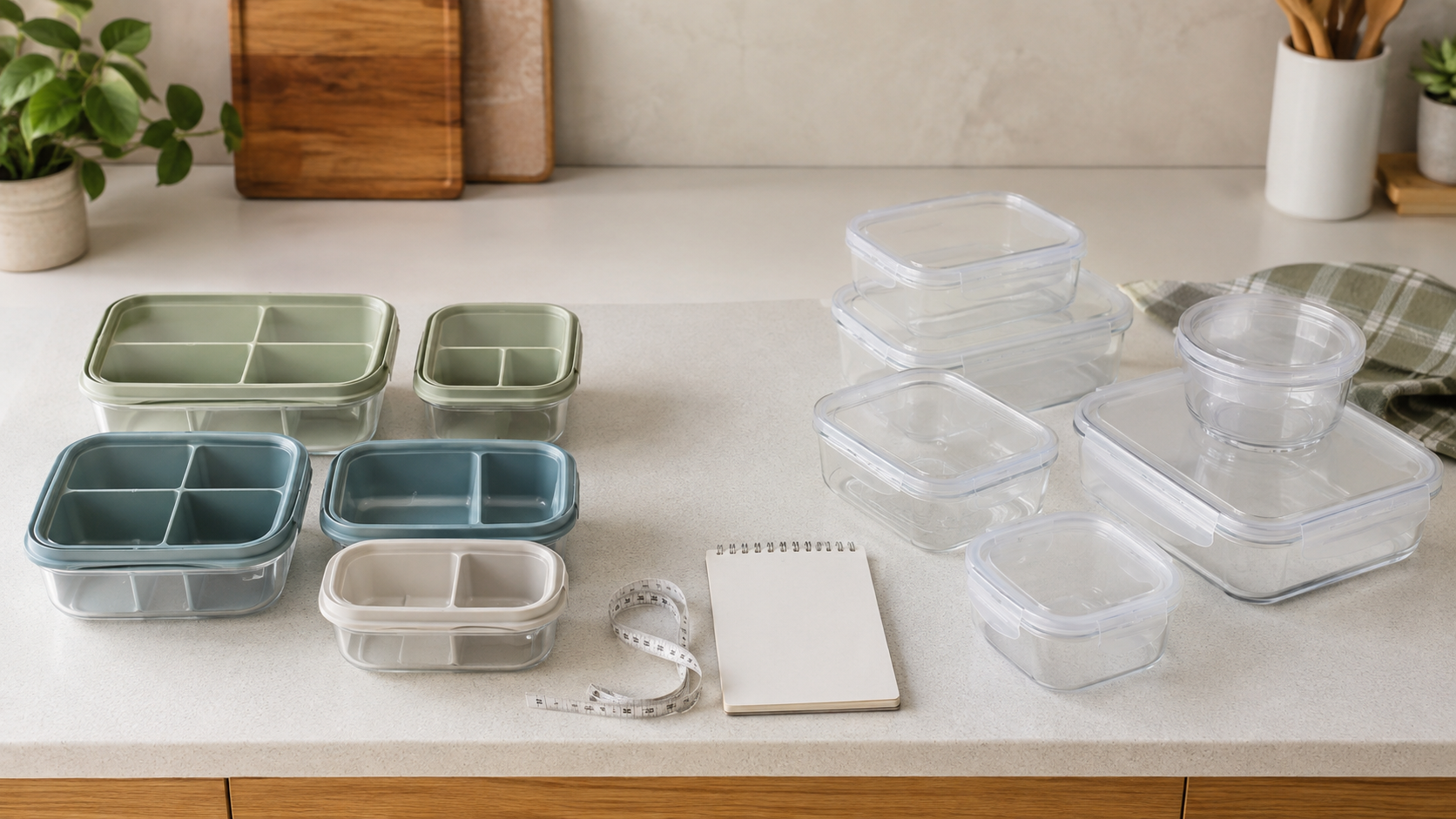
Portion-control containers divide or label the space before food is packed. Regular meal-prep containers leave the arrangement open. The better format is the one that fits the foods, storage, transport, and level of structure you actually want—not the one making the louder weight-loss promise.
As an Amazon Associate, GoodWeighFinds earns from qualifying purchases.
The quick decision
- Choose portion-control containers when gentle visual structure helps with packing, the usual foods fit the compartments, and the labels do not create pressure.
- Choose regular meal-prep containers when meal size and shape change, mixed dishes are common, or you want one set to handle leftovers, lunches, and shared foods.
- Use both selectively when one or two divided containers solve a repeat packed-lunch job but plain containers handle everything else.
- Skip a new set when containers you own already fit, or when food rules, labels, and fixed sections make eating more stressful.
What is actually different?
Portion-control sets commonly use fixed compartments, color coding, printed categories, or coordinated sizes. Those features can make repeated packing more predictable. They do not establish how much any individual should eat, and the word “portion” is not evidence that a set supports a health outcome.
Regular meal-prep containers are ordinary food-storage vessels used for preparing food ahead. They may be divided or undivided, but they generally avoid a prescribed system. Their advantage is adaptable space: a sandwich, soup, mixed dish, leftovers, or a shared batch can go into a size that fits the job.
Where portion-control containers fit
A divided layout can be useful when foods need to stay separate or when the same kind of lunch is packed repeatedly. It may also reduce the number of small loose containers in a bag. Look beyond the number of compartments: compare their actual length, width, depth, and stated capacity with what you carry.
The format becomes less useful when compartments are too small for the usual foods, the labels turn flexible guidance into rigid rules, or a large coordinated set creates a lid-and-storage problem. Color coding can aid quick matching, but it can also feel conspicuous in a shared fridge or workplace.
Where regular containers fit
Plain containers suit routines that change from day to day. A set with a few useful sizes can hold a single lunch, ingredients prepared ahead, leftovers, or a larger shared dish. Undivided space wastes less capacity when the food does not fit a fixed grid.
More flexibility does not automatically mean less work. A set with many unrelated shapes can be hard to stack, and mismatched lids can slow packing. Choose regular containers by repeated jobs rather than buying the largest piece count. The recent buy, reuse, or wait audit can help establish whether any new set is needed first.
Compare these tradeoffs
- Usable capacity: Treat the stated total as a starting point. Compartments, rounded corners, lid recesses, and fill lines can change usable room.
- Food flexibility: Fixed sections suit separated components; open containers better accommodate soups, sandwiches, mixed dishes, or irregular leftovers.
- Emotional fit: Neutral structure may be useful. Calorie labels, body-result language, or rigid color rules may add pressure and are reasonable reasons to skip.
- Lid workload: Count unique lid shapes, tabs, seals, and gaskets. Check whether replacements are sold for the exact line.
- Cabinet and fridge fit: Measure the full nested stack and the footprint of a packed container, not just one empty base.
- Bag fit: Compare the exterior dimensions with the lunch bag opening and usable interior, including room for an ice pack if used.
- Appliance labels: Check each component separately. A base, lid, gasket, or divider may have different microwave, freezer, and dishwasher instructions.
- Cost pattern: Compare the pieces you will use and can replace—not the advertised piece count, which may count every lid separately.
Run a no-cost packing test
Before buying, sketch the divided layout on paper or use small cups inside a container you already own. Pack two or three ordinary meals. Notice whether the sections match your food or force awkward substitutions, extra dishes, or unwanted rules. Then measure the needed exterior footprint and height.
This test separates a real format need from attractive organization. If an existing plain container works, the comparison is over. If food repeatedly mixes when you want it separate, one divided container may be more useful than a full system.
Setup and maintenance
When a set arrives, inspect it against the listing before use. Match each base and lid, confirm the dimensions and care labels, and check that the closures work without unusual force. Follow the maker’s washing and appliance directions; do not assume every part has the same temperature limits.
Choose a storage method before removing return packaging. Nested bases save space only if lids have a clear home. Dry all seams and gasket channels according to the care instructions before nesting. Replace pieces that are damaged or no longer close as intended rather than relying on a diet-branded promise of longevity.
Claims and labels to reject
Neither container format causes weight loss, controls appetite, speeds metabolism, or supplies a universally correct amount of food. Skip listings that promise automatic calorie control, guaranteed pounds lost, a rapid transformation, or a “perfect” portion for every adult. Customer anecdotes and before-and-after images do not prove that a container produced a result.
A fixed system can also be a poor fit for people who have individualized nutrition needs or find portion tracking distressing. If deciding how much to eat involves a medical condition, pregnancy, medication effects, unexplained weight change, or an eating-disorder history, a qualified healthcare professional is a more appropriate source than a container chart.
Who should skip which format?
Skip portion-control containers when fixed sections conflict with the foods you enjoy, the labels create guilt or restriction, the smallest sections go unused, or you mainly store soups and mixed dishes. Skip regular sets when a repeated need for separation means you keep adding disposable bags or several tiny vessels to every lunch.
Skip both when current containers already cover the routine, storage is tight, matching lids is already frustrating, or the purchase is driven mainly by weight-loss branding. A small number of ordinary containers in measured sizes is a complete solution if it does the work.
Related decisions
If you have already chosen a format, use the portion-control container guide or the broader meal-prep container guide for selection criteria. For at-home visual cues versus portable storage, compare portion-control plates and containers. For near-term lunches versus longer frozen storage, use the meal-prep versus freezer-container comparison.
This page supports the routine-support tools pillar, which starts with the practical job and keeps body-result promises out of ordinary kitchenware decisions.
Bottom line
Choose portion-control containers for a repeat separated-food job and a level of structure that feels genuinely useful. Choose regular meal-prep containers for flexible foods, portions, and storage jobs. Buy the smallest configuration that solves the measured problem, and skip any system that turns a practical container into a promise about your body.