Separate bags or no extra layer
Reusable Produce Bag vs Hand Basket for Grocery Shopping
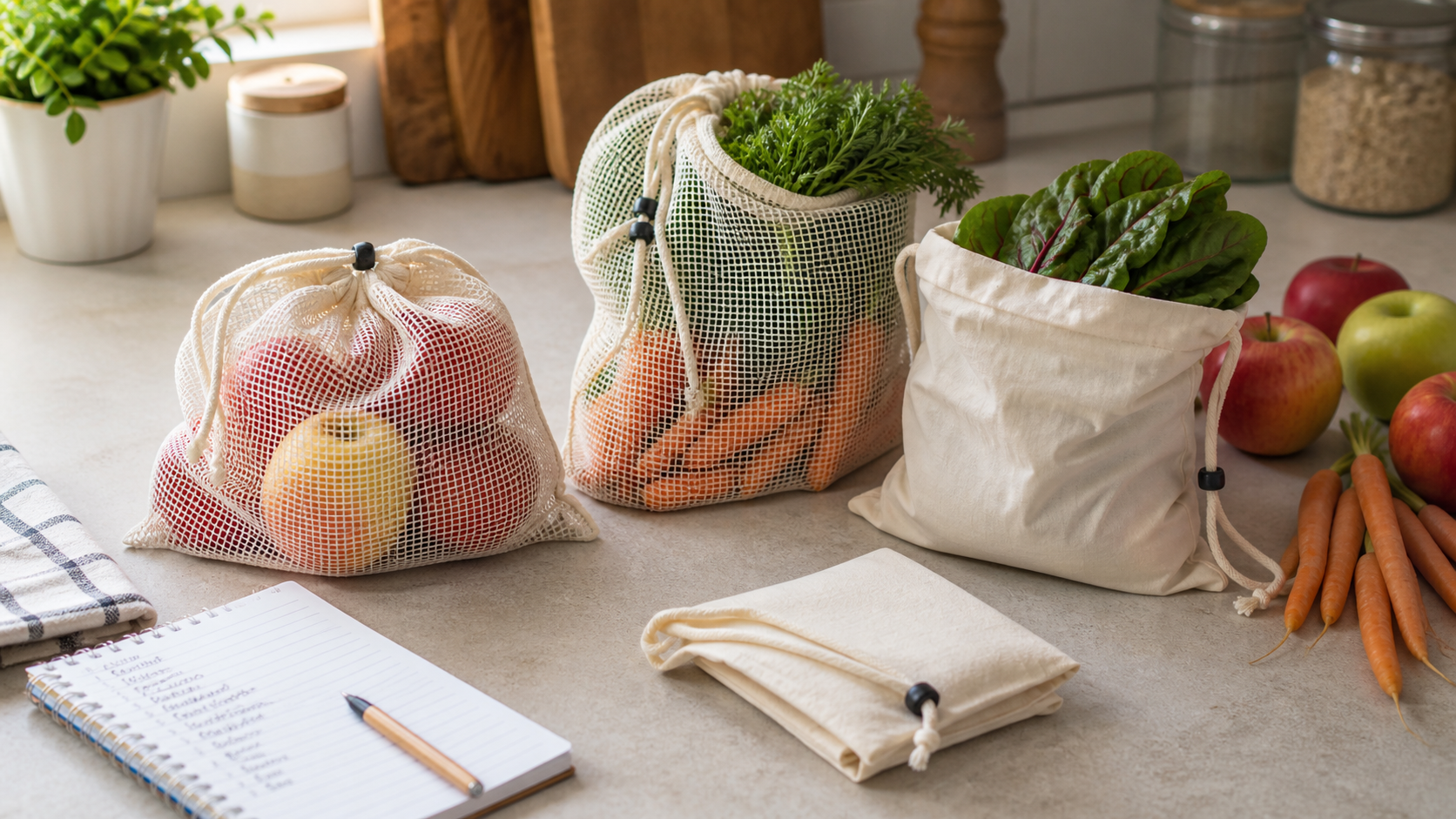
A reusable produce bag can keep small loose items together from the produce aisle through the trip home, but it adds a store-rule check plus washing, drying, and remembering. Using the store hand basket without separate bags is simpler for a small, sturdy selection, but loose items still need a workable checkout and take-home plan. Start with an ordinary shop, not an idealized zero-clutter routine.
As an Amazon Associate, GoodWeighFinds earns from qualifying purchases.
The quick comparison
- Reusable produce bag: may fit repeated purchases of small loose items that need grouping, provided the store accepts the format and the bag will be washed, dried, and returned to the shopping kit.
- Hand basket alone: may fit a small number of larger or sturdy loose items when separate containment is unnecessary and the checkout process permits it.
- Use both selectively: put only the items that genuinely need grouping in one or two suitable bags and leave the rest loose in the basket.
- Skip a purchase: use accepted bags already at home or no separate bag when that works; buying a set is not required to test the routine.
Who reusable produce bags fit
Separate bags fit shoppers who repeatedly buy small loose items that become awkward to count, move, or identify when spread through a hand basket. Review several real shopping lists and note how many groups—not individual pieces—would benefit from containment. A multi-bag set is unnecessary when one bag would cover the normal shop.
Before relying on any reusable bag, check the store's current policy and checkout process. A printed tare value is information about the bag's stated empty weight; it does not guarantee that a particular store will accept or subtract it. Compare visibility, closure, full dimensions, and care labels with the produce you actually buy. Do not infer freshness, contamination control, strength, or environmental superiority from the product format.
Who a hand basket without separate bags fits
The basket-alone approach fits a short list of larger, sturdy produce when the store permits loose items and the checkout handoff remains straightforward. It avoids owning and maintaining another item, but it is not literally bag-free if the produce still needs an accepted container after checkout. Decide before shopping whether items will move into an existing grocery bag, cart, box, backpack compartment, or another allowed take-home container.
Consider ordinary basket handling. Small items can spread under other groceries, and tender items can be crowded by heavier purchases. That does not automatically justify a new product: changing the order in which items enter the basket, keeping a clear section, or using one suitable bag already owned may be enough. Follow store instructions rather than assuming every loose item can move through checkout in the same way.
Tradeoffs that decide the format
- Grouping: a separate bag keeps a group together; the basket alone works best when there are few pieces and separation is not needed.
- Checkout visibility: mesh may leave contents visible, while dense fabric may need opening. Loose items are visible but may require individual handling.
- Weighing workflow: store systems differ. Verify the current process instead of treating a tare label or a past visit as universal policy.
- Trip home: a produce bag can transfer as one group, while loose items need a deliberate place in the take-home container.
- Maintenance: reusable bags require label-directed washing, complete drying, storage, and a return-to-kit habit; the store basket does not come home.
- Storage and clutter: bags need a dependable home. A large set adds sorting and storage without proving that every piece will be used.
Setup and maintenance
For reusable bags, choose a fixed number based on a normal trip and give them one storage location. Follow the exact washing and drying directions for the bag material; “washable” does not establish machine settings or dryer compatibility. Inspect seams, closures, labels, and fabric before reuse, and retire a damaged bag rather than relying on unsupported strength claims. Put clean, fully dry bags back with the grocery tote, cart, keys, or list so the routine has a clear reset step.
For basket-only shopping, the setup is a checkout and transfer plan. Keep items visible and avoid loading heavier groceries over items that can be damaged. At checkout, follow staff direction and move purchases into the intended take-home container. The store basket stays at the store; never treat it as transport equipment beyond the retailer's permitted area.
Run a no-buy test first
For two ordinary shops, bring one clean, suitable reusable bag already owned, if available, but use it only for items that clearly benefit from grouping. Leave other accepted items loose in the basket. Note four things: whether the bag was remembered, whether checkout handling was straightforward, whether the trip home needed separation, and whether washing and returning the bag happened without friction.
If no existing bag is suitable, the basket-only side can still be tested without buying anything. The goal is to locate the repeated problem precisely. A category purchase makes sense only if item grouping is the missing function and the store workflow, care routine, and storage location are already clear.
Skip criteria
- Skip new produce bags if the usual shop contains few loose items or those items do not need separate grouping.
- Skip a bag whose dimensions, material, closure, care directions, or stated tare information are unclear.
- Skip relying on reusable bags until the store's current rules and weighing process are known.
- Skip the basket-alone approach when small items repeatedly scatter, checkout requires an accepted container, or the take-home transfer has no workable place.
- Skip a large set when one or two bags—or suitable bags already owned—cover the ordinary trip.
- Skip both rigid routines and choose item by item when the grocery list changes substantially from week to week.
Choose the workflow, then compare products
If separate grouping proves useful, the reusable produce-bag guide compares mesh, fabric, closure, dimensions, tare labeling, care, and folded storage without naming an unsupported winner. If the ownership decision is still unclear, use the reusable produce-bag worth-it test. For carrying the entire shop rather than separating produce inside it, compare a compact grocery cart with reusable grocery bags. Return to the routine-support tools guide for the broader reuse, test, buy, or skip framework.
Bottom line
Choose a reusable produce bag when a repeated group of loose items needs containment and the store, checkout, cleaning, drying, and return-to-kit steps all fit. Use the store hand basket without separate bags when the selection is small, sturdy, permitted, and easy to transfer after checkout. A selective mix is often more practical than making every item follow one rule.