Open bowl or lidded caddy
Scrap Bowl vs Countertop Compost Bin for Prep Scraps
Use an open scrap bowl when scraps leave the counter at the end of the current prep session. Consider a lidded countertop compost bin when accepted organics remain indoors longer and a dedicated carry-and-empty routine fits the kitchen. The destination and holding time decide this choice before lid style, capacity, or appearance.
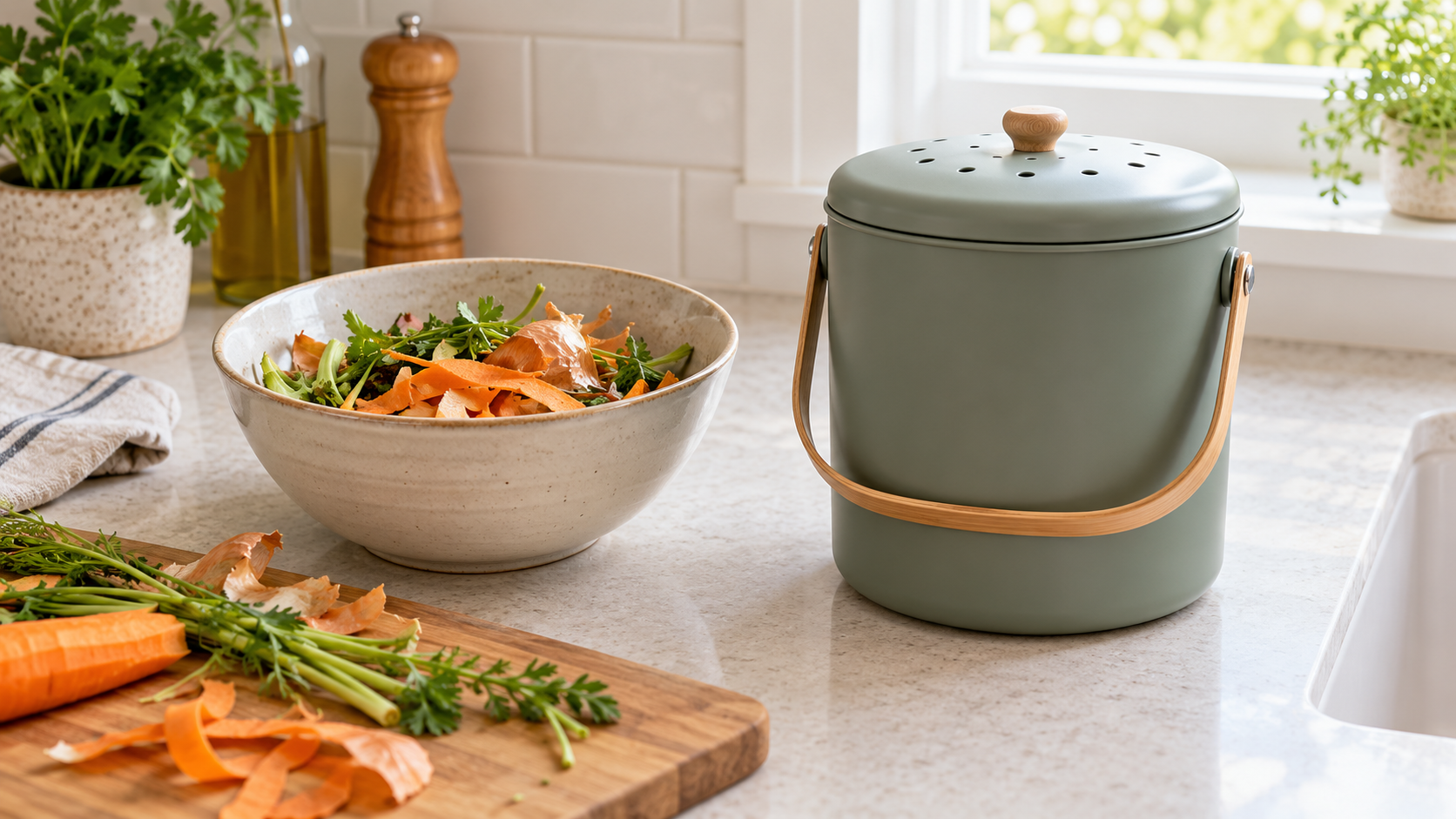
Quick decision: start with time and destination
| Decision | Scrap bowl | Countertop compost bin |
|---|---|---|
| Typical job | Open collection during active prep | Dedicated holding between transfers |
| Destination | Trash, accepted organics, or another established route | Confirmed local organics or home-compost route |
| Setup | Place an existing bowl beside the work area | Confirm footprint, lid clearance, liner rules, and emptying route |
| Upkeep | Empty and wash after the session | Empty, wash, dry, inspect lid and handle, and replace only approved consumables |
| Best no-buy test | Borrow a washable bowl for three prep sessions | Trial a suitable lidded container after confirming the destination |
The GoodWeighFinds editorial desk checked the EPA's Composting At Home guidance for this destination-first rule: home composting and municipal or community collection are different routes, and accepted materials can differ, so confirm the specific destination before collecting scraps for it. This source supports only that downstream-route and material-acceptance guidance; it does not establish odor control, food safety, or container performance.
Who an open scrap bowl fits
A bowl fits a cook who wants a wide target for peels, stems, and other ordinary prep discards, then empties it when the session ends. It is the lower-complexity format: no special liner, filter, hinge, or lid is required. A mixing bowl already in the cabinet is the first model to test.
Measure the space beside the cutting board, including the hand path used to move scraps. Compare the bowl opening, base, height, rim grip, empty weight, expected loaded weight, cleaning directions, and stored shape. Keep materials needing a different handling or disposal process out of a generic scrap-bowl assumption.
Who a countertop compost bin fits
A dedicated bin fits only after the household has confirmed where the collected material goes and what that destination accepts. It can organize a repeated between-transfer routine, but the lid does not establish odor, pest, leak, hygiene, or food-safety performance. Those are product- and use-specific claims to verify or leave unassumed.
Measure the complete exterior footprint and the clearance needed to open or remove the lid. Check the usable opening, handle, liner requirements, current local program rules, exact washing directions, replacement-part needs, seller, and returns. Include the route from counter to collection point; a compact-looking bin can still be awkward when full.
Tradeoffs that matter
- Holding time: a bowl is deliberately temporary; a bin adds a between-session holding step that must be managed.
- Visibility: an open bowl makes fill level and contents easy to see. A lid hides the contents but adds a surface and mechanism to handle and clean.
- Counter use: compare complete working footprints, including a flared bowl rim, bin handle, and lid swing or lift path.
- Carrying: test the bowl's rim or grips against the bin's handle and full load. Marketing photos do not prove control or comfort.
- Supplies: a bowl usually needs no dedicated consumable. A bin may specify liners or filters, but those must fit both the exact model and the destination's rules.
- Storage: a bowl may nest with cookware; a dedicated bin normally keeps permanent counter or cabinet space.
Setup and maintenance
For a bowl, mark its base and opening on the proposed counter spot, then use an existing washable vessel for three normal prep sessions. Record the largest one-session volume, number of transfers, loaded carry, washing, drying, and where the bowl goes afterward. Shop only if a different geometry or grip would fix a repeated problem.
For a bin, confirm the downstream collection route first. Mark the full product dimensions and lid clearance, then trial the workflow with a suitable lidded container if possible. Decide when it will be emptied, where each part will be washed and dried, and who will inspect handles, hinges, seals, filters, or liners. Follow the exact maker directions and local collection rules instead of assuming a universal routine.
A one-week decision worksheet
| Record | Why it changes the choice |
|---|---|
| Prep sessions and largest scrap load | Shows whether a temporary bowl has enough usable volume |
| Hours before the next accepted transfer | Separates same-session collection from between-session holding |
| Available width, depth, and lid clearance | Tests the complete working footprint |
| Emptying, washing, and drying steps | Reveals the maintenance each format actually adds |
| Destination and accepted materials | Prevents buying a compost-labeled container without a workable route |
This is a hypothetical household trial, not a food-safety test or evidence that either format controls odor or pests.
Skip criteria
- Skip both purchases if direct board-to-destination transfer already works.
- Skip a dedicated bowl if an existing washable vessel fits the counter, carrying, cleaning, and storage routine.
- Skip the open bowl when the actual need is managed holding between prep sessions rather than temporary collection.
- Skip the compost bin when no confirmed organics or home-compost destination exists.
- Skip either listing when dimensions, materials, care instructions, required supplies, seller, or return terms are unclear.
- Skip claims that a lid, filter, coating, or material universally prevents odor, pests, leaks, contamination, or maintenance.
Compare models only after choosing the format
If same-session collection wins, use the countertop scrap-bowl guide to compare opening, base, loaded carry, nesting, and care. If a dedicated lidded caddy still earns its space, first use the compost-bin ownership test, then compare countertop compost-bin formats. The routine-support tools guide keeps the wider product decision focused on practical friction instead of body-result marketing.
As an Amazon Associate, GoodWeighFinds earns from qualifying purchases.
Bottom line
Choose an open scrap bowl for a short, visible collect-and-empty loop during active prep. Choose a countertop compost bin only when accepted scraps need managed holding and the destination, footprint, lid, carrying, supplies, cleaning, and drying routine all work. Test what you own first; neither format deserves counter space merely because it is marketed for meal prep or composting.