Meal-prep cleanup buying guide
How to Choose Countertop Scrap Bowls for Meal-Prep Cleanup
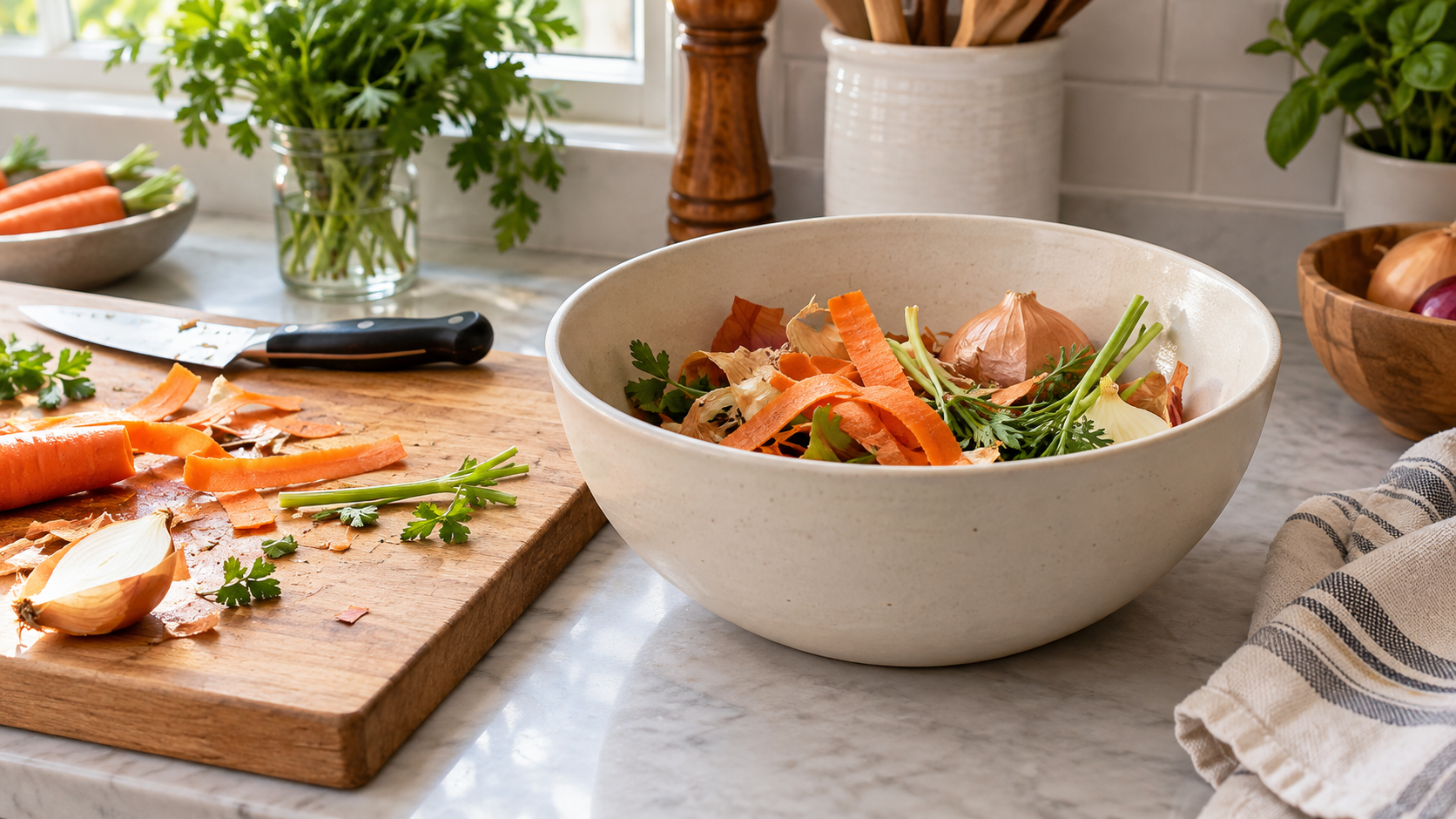
A scrap bowl can keep peels, stems, wrappers, and other prep discards in one temporary landing spot. The useful choice is a plain vessel that fits beside the cutting board, stays steady, carries comfortably, and cleans without fuss—not a special-purpose product that promises odor, pest, hygiene, or food-safety benefits.
As an Amazon Associate, GoodWeighFinds earns from qualifying purchases.
Quick answer: use the simplest bowl that fits
| Format | Useful when | Check first |
|---|---|---|
| Wide, low bowl | You want a nearby target for peels and dry scraps during one prep session. | Base stability, opening width, counter footprint, and rim grip. |
| Handled bowl | The transfer route is long enough that a dedicated grip is useful. | Handle clearance, attachment, balance, full weight, and storage. |
| Lightweight metal or plastic bowl | Low empty weight and easy carrying matter more than heft. | Base movement, rim shape, material and care labels, and nesting. |
| Bowl you already own | Your current mixing bowl fits the scraps and can be washed before its next use. | Whether reusing it creates any actual conflict in the prep sequence. |
Define the temporary job
This guide covers open bowls used while actively preparing food, followed by prompt transfer to the household's normal trash, organics, or other accepted route. It does not cover holding scraps on the counter between meals. If that boundary is still unclear, compare a scrap bowl with a lidded countertop compost bin before choosing a format. If the problem is longer collection, a lid, liner, filter, or municipal compost setup, use the countertop compost-bin guide instead.
Start by watching two or three ordinary prep sessions. Note what lands in the bowl, the largest one-session volume, where it sits, and how far it travels afterward. Keep raw-meat packaging, liquids, sharp fragments, and anything else requiring a different disposal or cleanup process out of a generic category assumption; the bowl itself does not make mixed scraps safer to handle.
Measure opening, base, and usable counter space
A capacity number is less useful than the actual geometry. Mark the listed opening and base on the counter with paper. Leave room for the cutting board, knife placement, ingredients, and the hand path used to move scraps. A large rim may be easy to hit but can crowd a compact prep zone.
- Opening width: Compare it with the edge of the cutting board and the handfuls or peelings you normally transfer.
- Base diameter: A broad-looking bowl may taper to a small contact area. Check the stated base measurement when available.
- Height: Taller sides can contain a larger pile, while a low bowl may be easier to reach over and inspect.
- Full weight: Add the expected scraps to the empty product weight. A stable ceramic bowl may become awkward to carry; a very light bowl may shift during use.
- Clearance: Include handles and flared rims, not just the nominal body width.
Choose a carry method you can actually use
A plain rolled rim may be enough for a short transfer. A side handle can provide a clearer grip but also changes balance, storage, and counter clearance. Two small grips may support a two-handed carry, while an open loop needs enough room for the intended hand position. Product photos do not establish comfort or control, so check dimensions and the return policy.
Do not treat a handle as proof that a bowl is safe to carry when full. Avoid overfilling, keep the path clear, and use the maker's instructions for the exact vessel. If mobility, grip, balance, or reach is a concern, choose a transfer setup appropriate to the person and space rather than relying on a generic product label.
Compare materials by labeled use and care
Stainless-steel bowls can be relatively light and may nest compactly, but base grip, edge finish, denting, surface changes, and care differ. Ceramic bowls add weight and may feel steady, but they can chip or break and may be harder to carry. Plastic bowls can be light and come in many shapes, while heat limits, staining, scratches, and dishwasher directions vary by product.
Read the exact material and care wording. “Dishwasher safe” may include rack placement or temperature limits. If a bowl is also sold for food preparation, keep its scrap-collection role and cleaning cycle clear before returning it to food use. A marketing phrase such as “easy clean” or “non-slip” is not a substitute for construction details and care instructions.
Check nesting and storage after use
If the bowl must disappear between sessions, compare its complete stored shape. A flared rim, projecting handle, rubber base, or hooked feature can prevent otherwise similar bowls from nesting. Check whether the bowl must be fully dry before it returns to a stack and whether its base or rim could rub against another surface.
A dedicated scrap bowl is not automatically more convenient than borrowing a mixing bowl. If nesting it forces other cookware out of place, a smaller existing vessel or direct transfer from the board may be the better routine.
Run a no-purchase test
- Choose a washable bowl already in the kitchen.
- Place it in the proposed counter spot for three typical prep sessions.
- Record the largest scrap volume, counter space used, number of transfers, and whether carrying or cleaning caused friction.
- Measure the trial bowl's opening, base, and height.
- Shop only if a different size, grip, weight, or stored shape would solve a repeated problem.
This trial turns a vague product search into measured criteria and may show that no dedicated purchase is needed.
When to skip a scrap bowl
- An existing mixing bowl, plate, paper bag, or direct board-to-bin transfer already works without disrupting prep.
- The available counter area cannot hold another item without crowding the cutting or knife zone.
- You need between-meal storage rather than short-session collection.
- The listing omits dimensions, material, care instructions, or usable return terms.
- The only appeal is an unsupported odor-control, pest-control, hygiene, or food-safety promise.
- The bowl would add a separate washing and storage task without reducing a repeated cleanup problem.
Keep the cleanup path connected
For dry crumbs and small trimmings already scattered on the work surface, compare a bench scraper with a countertop crumb tray; either may fit that transfer job better than adding another bowl. For longer scrap holding, first decide whether a countertop compost bin earns its space. The broader routine-support tools guide explains how to choose ordinary kitchen helpers by the friction they remove rather than by weight-loss marketing.
Bottom line
The best countertop scrap bowl is often a bowl already in the cabinet. If a dedicated one would solve a repeated problem, compare measured opening and base size, full carrying weight, grip, material instructions, washing, nesting, and the transfer route. Keep it a temporary prep tool, and skip any listing that turns an ordinary bowl into unsupported odor, hygiene, safety, or health claims.