Visible counter access or divided drawer storage
Utensil Crock vs Drawer Organizer for Meal-Prep Tools
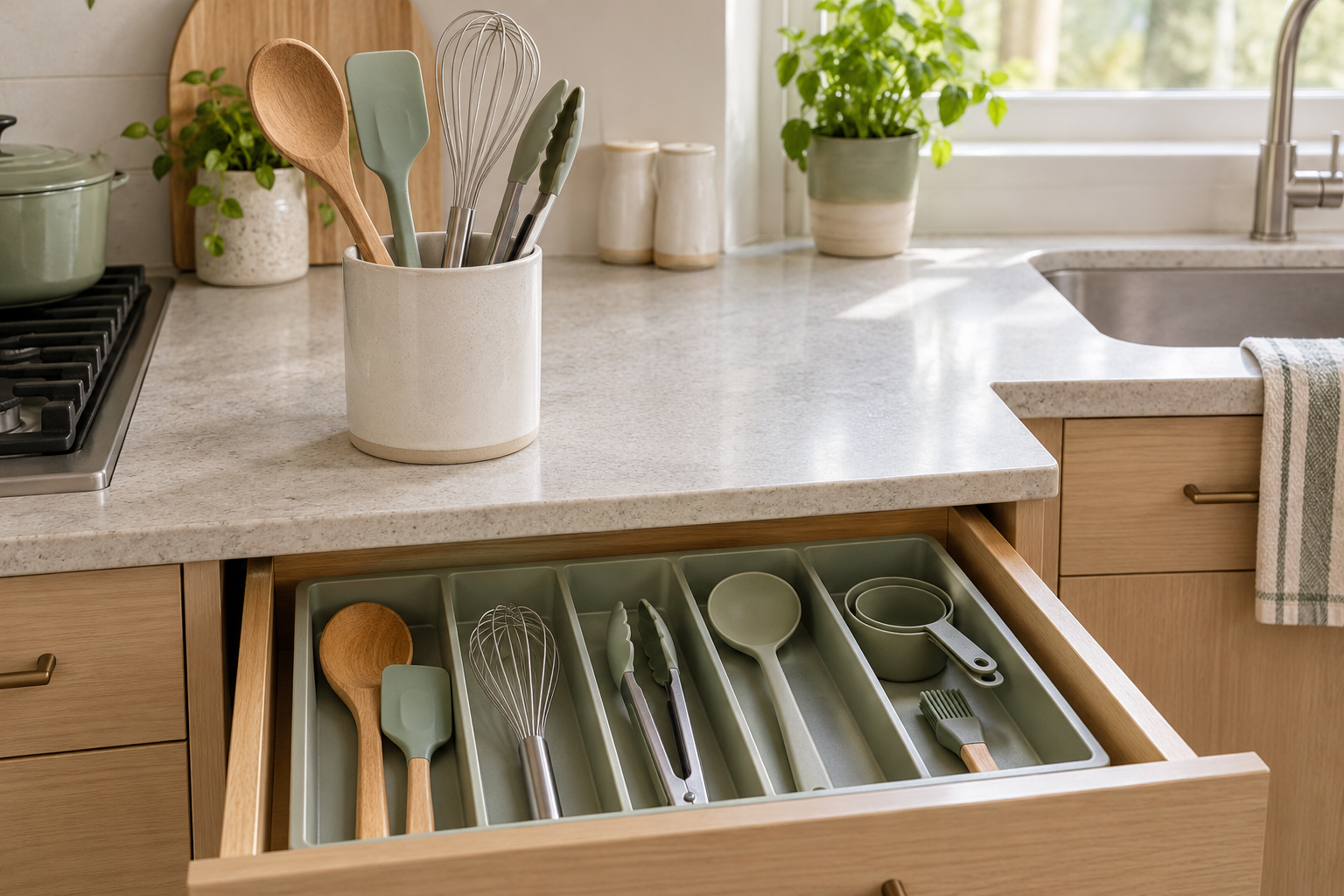
A utensil crock keeps tall, frequently used tools visible beside the work area. A drawer organizer moves tools off the counter and separates them into low compartments. The useful choice depends on which space is scarce, the tools you reach for, drawer clearance, cleaning, and whether your current storage can be rearranged for free.
As an Amazon Associate, GoodWeighFinds earns from qualifying purchases.
The quick comparison
| Decision | Utensil crock | Drawer organizer |
|---|---|---|
| Best fit | A short list of tall tools used most days | A broader set that benefits from separation |
| Space used | Counter area plus overhead reach | Drawer width, depth, height, and opening clearance |
| Access | Tools stay visible and can be lifted out | Open the drawer, then select from compartments |
| Main friction | Crowding, tipping, and residue around the base | Tool overlap, snagging, and lost usable drawer space |
| Cleaning | Empty and wash or wipe the vessel and counter | Lift out or empty the tray and clean the drawer beneath it |
| Skip when | Counter space is the tighter constraint | The drawer is shallow, narrow, or already needed for other tools |
Who a utensil crock fits
A crock is the simpler match when you use the same handful of long tools repeatedly and have a stable counter location near the prep or cooking area. Measure the crock opening and height against wide spatulas, whisks, tongs, and ladles. Also check the full lifting path under shelves or cabinets. A tall tool that fits inside but cannot be lifted clear does not fit the space.
Favor a wider, lower vessel only when its listed dimensions suit the tools and the available counter. Do not assume a heavy-looking material cannot tip, that a finish will protect every counter, or that a listing's stated capacity reflects your mix of handles and tool heads.
Who a drawer organizer fits
A drawer organizer fits when clearing the worktop matters more than keeping tools visible, and a drawer has enough usable interior room. Measure inside width, depth, and height with the drawer fully closed. Then measure the tallest tool head and any handles that could catch the cabinet frame.
Compartments can separate small and medium tools, but fixed dividers may waste space around unusually wide utensils. An expandable tray needs both its minimum and expanded measurements checked; expansion does not create extra drawer volume. If your longest cooking tools must lie diagonally, test that layout in the bare drawer before buying anything.
Setup and maintenance tradeoffs
For a crock
- Choose a location outside direct splash or heat zones and follow the tool and appliance instructions.
- Keep the load loose enough that one tool can leave without pulling others with it.
- Empty it regularly so crumbs or cooking residue do not stay hidden at the bottom.
- Verify maker-stated care directions instead of assuming ceramic, metal, or plastic is dishwasher-safe.
For a drawer organizer
- Confirm the loaded tray does not block the drawer from closing.
- Check whether feet, liners, or an exact fit limit shifting; do not assume a generic tray is non-slip.
- Remove the organizer for cleaning and check the drawer corners beneath it.
- Reassess rarely used tools rather than filling every compartment by default.
Run a no-buy test first
- Set aside only the cooking tools used during one ordinary week.
- Place the tall daily-use tools together in an existing sturdy container for two days, away from heat and splashes.
- For two more days, lay the same set in the candidate drawer using small existing boxes as temporary dividers.
- Notice whether counter loss, drawer opening, visibility, crowding, or cleanup creates the bigger nuisance.
- Buy only if the preferred format solves that repeated nuisance and the measured product fits.
This test is about kitchen workflow, not nutrition or weight-loss outcomes. Storage can reduce search friction, but it does not make a routine effective by itself.
Skip criteria
- Skip both if rearranging a current drawer or reusing a stable washable container solves the problem.
- Skip the crock if it would sit beside a hot burner, crowd the main prep area, exceed overhead clearance, or invite more tools than it can hold loosely.
- Skip the drawer organizer if the drawer cannot close with the tallest tool, compartments do not match the actual set, or the drawer is more valuable for other essentials.
- Pause on the listing when dimensions, material, care directions, seller, or return terms are unclear.
Next steps
Use the routine-support tools guide to keep this purchase in context: practical tools may support a workflow, but they do not promise body results. If the counter is crowded by prep tools rather than stored utensils, compare a bench scraper with a countertop crumb tray. If cabinet storage is the real constraint, the cutting-board organizer guide and pot-lid organizer guide use the same measure-first approach.