Small-kitchen recipe display comparison
Magnetic Recipe Holder vs Cookbook Stand for Small Kitchens
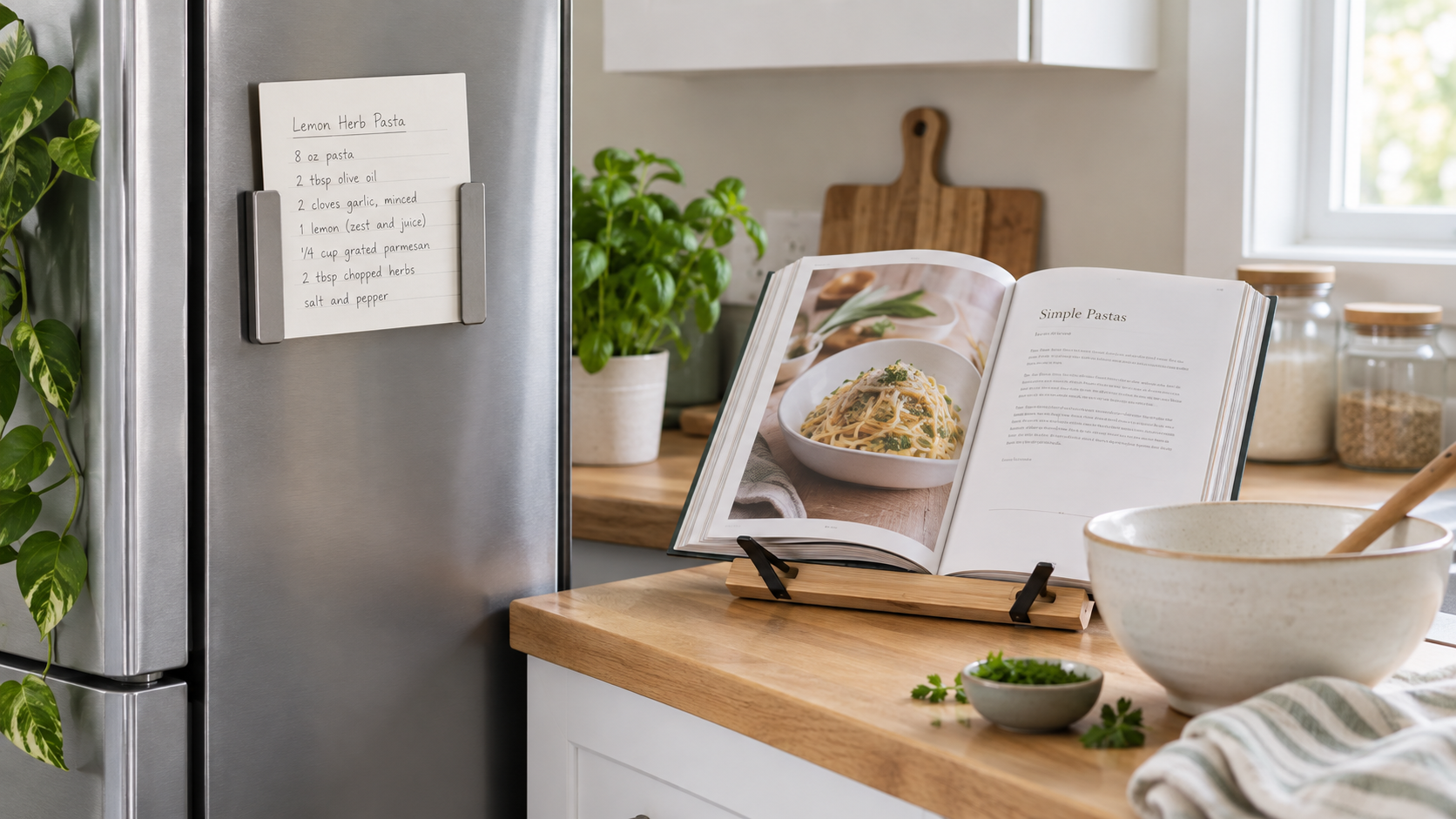
Choose a magnetic holder when a compatible vertical surface puts a card or sheet in a useful sightline without using the counter. Choose a cookbook stand when you need broader format support, adjustable viewing, or the freedom to move the recipe between work areas.
As an Amazon Associate, GoodWeighFinds earns from qualifying purchases.
The quick comparison
| Decision | Magnetic recipe holder | Cookbook stand |
|---|---|---|
| Placement | Compatible vertical metal surface | Flat counter or table |
| Recipe formats | Usually cards or sheets within stated dimensions | Books, sheets, cards, or devices only when explicitly supported |
| Working footprint | Uses door or side-panel area | Uses counter depth and width |
| Repositioning | Limited to compatible surfaces and door movement | Moves between stable work surfaces |
| Setup check | Surface, magnet coverage, sightline, and clearance | Base, ledge, angle, page support, and open dimensions |
| Main friction | May not fit the surface or recipe format | Can crowd a small prep zone |
Who each format fits
A magnetic holder fits a cook who mostly uses one card or sheet and already has a compatible refrigerator side or other maker-approved surface near—but not inside—the prep path. It is useful only when the text remains readable and the appliance door can move normally.
A cookbook stand fits a cook who changes between books, loose sheets, and possibly a device that the stand is explicitly designed to support. It trades counter space for portability and, on some models, angle adjustment. Neither format improves the recipe, protects every item from spills, or makes cooking safer by itself.
Check setup before shopping
For a magnetic holder, test the exact location with an ordinary magnet and a paper recipe. Some stainless-looking appliance panels are not magnetic, and a surface that holds a small magnet may not support a larger holder as claimed. Open the door fully and check handles, hinges, cabinets, walking clearance, and the sightline from the normal work position.
For a stand, measure the open base, rear support, front ledge, and the space needed to turn pages. Place a similarly sized object on the intended counter to see whether it blocks a cutting board, cabinet door, outlet, or ingredient path. Keep either format away from burners, steam, splashes, and locations where a falling item could enter food.
Match the real recipe format
Measure the card, printed sheet, book, or device you actually use. A magnetic clip that holds one sheet is a different product from a tray-style holder. A stand with a shallow ledge may suit paper but not a thick cookbook; a deep ledge can cover text or controls. Treat “universal” compatibility as marketing unless the listing gives usable dimensions and limits.
If a device is involved, follow the device maker's heat, moisture, charging, and operating guidance. A listing photo is not proof that a stand supports a particular device size, case, or weight.
Setup and maintenance tradeoffs
Magnetic holders can leave the counter open, but their seams, clips, sleeves, and magnet covers still need cleaning. Check the appliance's finish-care instructions before attaching or sliding anything across it. Remove the holder to clean both surfaces rather than assuming “scratch-free” or “rustproof” language applies indefinitely.
Cookbook stands need a stable, dry base and enough rear clearance at the chosen angle. Hinges, ledges, page arms, and non-slip parts add cleaning points. Check whether the stand folds, how thick it is when stored, and whether wiping or washing is allowed for its material.
Cost and flexibility
A magnetic holder can be the smaller single-purpose purchase when the surface and recipe size are consistent. A stand usually works in more rooms and does not depend on an appliance finish, but it can cost more and occupy scarce counter or cabinet space. Include replacement clips, sleeves, pads, or hardware only when the maker identifies them as replaceable.
Before buying, repeat the task with a magnet or clip already owned and prop a book against a stable object away from the active prep area. The test should reveal whether the actual problem is visibility, page control, recipe storage, or insufficient work space.
When to skip each option
- Skip the magnetic holder when there is no compatible surface, the appliance door moves through the work path, the recipe is too large, or reading it requires turning away from the task.
- Skip the cookbook stand when its open footprint crowds the prep zone, the ledge blocks important content, or there is no stable place to store it between uses.
- Skip both when an existing clip, binder, wall-safe method, or recipe placed outside the prep zone already solves the problem.
- Skip vague listings that omit dimensions, compatible surfaces or formats, care directions, seller identity, or workable return terms.
Next steps
If the vertical-surface idea passed the test, use the magnetic recipe holder worth-it guide for a deeper ownership check, then compare magnetic clips, sleeves, and ledges by measured recipe fit and loaded clearance. If a counter stand fits better, compare compact cookbook stands by footprint, ledge, angle, stability, cleaning, and storage. If the real problem is scattered loose recipes, the recipe binder versus cookbook stand comparison addresses organization versus display.
Bottom line
A magnetic holder is the space-saving choice only when a compatible surface creates a clear, useful reading position. A cookbook stand is the flexible choice only when its complete working footprint fits the counter and its support matches the recipe. Test placement and format before comparing models. This is a kitchen-workflow decision within the routine-support tools guide, not a weight-loss method.